How Does Tomoson Work? Understanding Its Influencer Marketing Process
November 15, 2026
0
Influencer marketing gives businesses a way to introduce products and services through people who already have an audience on blogs, social networks, and other digital channels. Instead of
Influencer marketing gives businesses a way to introduce products and services through people who already have an audience on blogs, social networks, and other digital channels. Instead of relying entirely on traditional advertising, brands can collaborate with creators who produce reviews, demonstrations, photographs, videos, and other content. However, finding suitable creators, organizing product deliveries, agreeing on requirements, and checking completed work can take considerable time.
This is where influencer collaboration platforms become useful. Tomoson has historically operated as a service connecting businesses with bloggers, reviewers, and social media influencers. Brands could use it to organize product campaigns, while creators could explore opportunities to test products and produce content in exchange for products or other agreed rewards.
If you are researching how does tomoson work, it is important to understand both its intended campaign process and its current website status. Tomoson’s published FAQs and older platform documentation describe a system in which brands create campaigns, influencers apply, businesses select participants, and creators complete agreed tasks. Its public website still displays influencer profiles, campaign listings, and pricing information. However, the registration and application experience is not fully verifiable through the current public pages.
This guide explains the platform’s documented approach, what brands and influencers should expect, how compensation and campaign responsibilities work, and what to check before attempting to join.
What Is Tomoson?
Tomoson is known as an influencer marketing platform designed to connect businesses with online creators. Its original service focused on helping brands find bloggers and social media influencers who could introduce products to relevant audiences. Rather than contacting every creator individually, businesses could use the platform to publish campaigns and review applications from interested participants.
For creators, Tomoson offered a place to discover product promotions and brand collaborations. Bloggers and influencers could provide information about their websites, social profiles, audience size, and content interests. Businesses could then consider whether those creators matched their campaign requirements.
The platform’s published materials describe several types of collaboration, including product testing, honest reviews, social media promotion, and content creation. Brands could promote physical products, digital products, services, events, and product launches, subject to the platform’s rules.
Tomoson therefore belongs to the wider category of influencer marketing, where businesses work with people who have established online audiences. Its historical approach emphasized campaign discovery, creator selection, product distribution, communication, and task verification.
It is worth separating Tomoson’s original service from the website visitors currently encounter. The public homepage now describes itself mainly as a source of digital insights and articles about influencer marketing, social media, and entrepreneurship. Separate legacy-style pages still display campaigns, influencer listings, FAQs, and subscription information. These pages provide useful information about the intended service, but they do not prove that every part of the original platform is currently operating normally.
How Does Tomoson Work From Start to Finish?
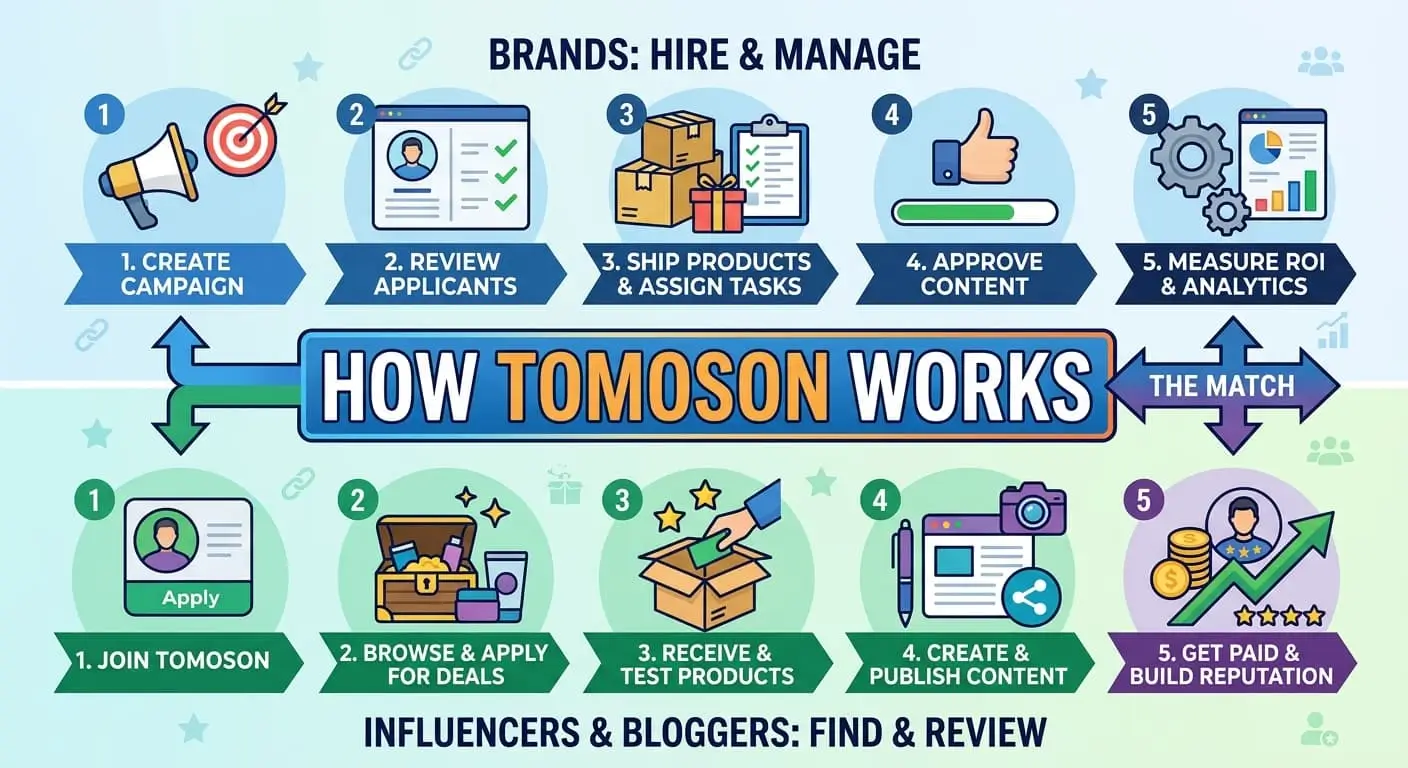
Tomoson’s published documentation describes a campaign-based process. The following steps explain how that system is intended to work. They should be understood as the documented workflow, not a guarantee that every step is currently available to new users.
1. A Brand Creates a Campaign
The process begins when a business prepares a campaign for a product or service. The brand describes what it wants to promote, what kind of content it needs, and which creators would be suitable.
A campaign may focus on product feedback, blog content, social media exposure, or other agreed deliverables. The business should provide an accurate description and explain the requirements clearly so applicants understand the opportunity.
2. Campaign Requirements and Rewards Are Established
The brand defines the type of creator it wants to reach. Published FAQs describe prerequisites such as a creator’s niche, audience size, website visitors, and social media presence.
The campaign also explains what participants receive. Depending on the offer, this may involve a free product, a discounted product, or another agreed arrangement. If content creation or promotional work requires payment, the compensation and deliverables should be clearly understood before participation.
3. Influencers Discover Available Opportunities
Tomoson’s public campaign directory displays product offers with campaign descriptions, brand names, and application links. Its published model allows creators to browse opportunities and identify promotions that match their interests and audience.
For example, a home and lifestyle blogger might be interested in a household product, while a pet-focused creator may prefer a campaign involving pet supplies.
4. Interested Creators Apply
A creator reviews the offer and decides whether to apply. The application process described in Tomoson’s FAQs considers whether the person meets the campaign’s requirements.
Creators should check the product, expected content, deadline, shipping arrangements, and compensation before committing. Applying simply because a product looks attractive can lead to problems if the creator cannot complete the requested work.
5. Brands Review and Select Participants
Businesses review the applicants and choose creators who appear suitable. Tomoson’s influencer FAQ explains that creators meeting campaign prerequisites may be preapproved, but the brand makes the final selection.
This gives businesses an opportunity to assess niche relevance, audience information, and other profile details before distributing products.
6. Products or Agreed Compensation Are Provided
After selection, the brand arranges the product or other agreed reward. The influencer FAQ says most products are provided without charge, although some opportunities involve heavily discounted products.
The brand is responsible for following the campaign’s stated arrangements, including shipping products or providing a valid coupon code where applicable.
7. Creators Complete the Required Content
The creator tests the product and prepares the agreed content. Depending on the campaign, this may involve a blog review, social media post, photographs, or another specified task.
Tomoson’s published influencer guidance emphasizes original content, timely completion, and valid links to the finished work. It also states that product reviews should be honest rather than automatically positive.
8. Work Is Submitted and Verified
The creator provides the relevant link or evidence of completion. Tomoson’s brand FAQ describes a dashboard process in which verified work and review links can be found under a campaign’s Completed section.
The documentation also explains that invalid submissions may be investigated. For example, copied content, an incorrect product review, or a link that does not lead to the required post may fail verification. <Cite refs={[“turn382133view4″,”turn180004view0”]} />
How Tomoson Works for Brands
For businesses, Tomoson was designed to simplify the process of finding creators and organizing product-focused campaigns. A brand that wants to introduce a new item may not have the time or resources to contact dozens of bloggers individually. A campaign marketplace can help bring interested creators into one process.
Preparing a Campaign Brief
The first responsibility is to explain the campaign clearly. A useful brief identifies the product, its intended audience, the type of content requested, and the expected completion period.
For example, a business promoting a kitchen accessory might want creators who regularly publish home, cooking, or lifestyle content. It could explain whether it wants a written product review, original photographs, or a social media demonstration.
A clear brief reduces confusion and helps creators decide whether the offer suits their audience.
Choosing Suitable Influencers
The largest audience is not necessarily the best audience. A creator with a smaller but highly relevant community may be more useful to a brand than someone with a much larger audience that has little interest in the product.
Tomoson’s published FAQs describe creator selection based on factors such as niche, website visitors, and social media followers. The brand can review applicants and set prerequisites to exclude unsuitable participants.
Businesses should also examine engagement and content quality rather than relying only on follower totals. Relevant comments, consistent publishing, and audience interest can provide a more meaningful picture of a creator’s suitability.
Managing Products and Shipping
Product delivery is a major part of product-testing campaigns. The business must provide the item in the condition and manner promised in the campaign.
Tomoson’s brand FAQ states that businesses are responsible for shipping new, unused products and extending a creator’s completion time if delivery or coupon-code problems cause delays. Shipping costs should be included in the campaign budget rather than treated as an afterthought.
Communicating With Creators
The published brand FAQ describes two communication options: an Invite System and a Message Center. The invite system is intended for sending offers and inviting creators to apply. The Message Center is described as a way to clarify campaign details, discuss shipping issues, and respond to requests for deadline extensions.
The documentation also places restrictions on how the message system should be used. It says brands should not use it to solicit unrelated business, request unnecessary personal information, or move campaign payments outside the platform in ways that violate its terms. <Cite refs={[“turn180004view0″,”turn180004view1”]} />
Measuring Campaign Results
Brands should evaluate more than the number of creators who accept an offer. Useful measurements may include completed posts, audience engagement, referral visits, content quality, and sales activity where tracking is available.
Tomoson’s historical product tour describes campaign exposure and engagement reporting. However, businesses should verify which analytics features are currently accessible before relying on them for a marketing plan.
How Tomoson Works for Bloggers and Influencers
For creators, Tomoson was intended to provide access to product opportunities and brand collaborations without requiring them to find every business independently.
The platform’s influencer FAQ states that registration is free for influencers. It also explains that brands use creator profiles and campaign requirements to decide whom they want to work with. <Cite refs={[“turn382133view4”]} />
Building a Useful Creator Profile
A creator profile should explain the subjects covered by their content and the audience they reach. A blogger who publishes detailed technology reviews, for example, should make that focus clear rather than presenting a profile that appears unrelated to the campaigns they want.
Useful profile information may include a website, social media channels, niche, audience size, and examples of previous work. Keeping these details accurate helps businesses evaluate whether a creator is suitable.
Finding Relevant Campaigns
Creators should look beyond the product name when reviewing an offer. A campaign might appear attractive but require content that does not fit the creator’s usual subject or audience.
Before applying, check the product, required content format, expected publishing location, deadline, compensation, and any conditions attached to receiving the item.
Understanding Approval
Submitting an application does not mean the creator has been selected. Tomoson’s published process gives brands the final decision after reviewing applicants against campaign requirements.
A complete profile may help a creator demonstrate suitability, but it does not guarantee approval. Campaigns can attract competition, and businesses may choose only a limited number of participants.
Testing Products and Creating Original Content
Once selected, a creator should follow the campaign instructions while maintaining editorial honesty. If a product has a limitation, the creator should not feel required to describe it as perfect simply to satisfy the brand.
Tomoson’s influencer guidance says products are provided for testing and honest reviews. It also warns against selling products received for review purposes and against publishing copied or invalid content. <Cite refs={[“turn382133view4”]} />
Meeting Deadlines
Creators should consider shipping time, product testing, and their existing workload before accepting an offer. The published FAQ says completion time begins when the product is shipped or a coupon code is uploaded.
If a delivery problem or another issue makes the deadline unrealistic, the creator should communicate with the brand through the designated channel rather than simply missing the deadline.
What Types of Campaigns Can Users Find on Tomoson?
Tomoson’s published materials describe campaigns involving product reviews, feedback, social media content, and other promotional activities. Its campaign pages also display offers under labels such as Social Deal.
The exact deliverables depend on the individual campaign. The following formats are relevant to the platform’s documented approach, but users should not assume every format is currently available.
Product Reviews and Feedback
Product-testing campaigns allow creators to try an item and share an honest assessment. These reviews may appear on a blog or another approved third-party platform, depending on the campaign requirements.
The brand FAQ specifically discusses campaigns with a Feedback goal and mentions third-party review destinations. The platform’s stated policy is that reviews should reflect genuine product experience, not simply repeat brand descriptions. <Cite refs={[“turn180004view0”]} />
Blog Content
Bloggers may be asked to publish an article describing a product, its features, or their experience using it. This format can give readers more detail than a short social post, particularly when the product requires explanation or comparison.
Social Media Promotions
Social campaigns can involve introducing a product to an audience through a creator’s social channels. The specific platform, format, and publishing requirements should be stated in the campaign.
Photographs and Videos
Brands may seek original visual content that demonstrates how a product looks or works. Product photographs and video demonstrations can help businesses communicate features in a more practical way.
Tutorials and Product Launches
Tomoson’s brand FAQ also describes campaigns for tutorials, services, events, apps, eBooks, and product launches. These examples show that the historical platform concept was not limited to physical product reviews. <Cite refs={[“turn180004view0”]} />
Does Tomoson Offer Free Products or Paid Opportunities?
Tomoson’s influencer FAQ says that most products offered through its campaigns are provided at no charge, while some are available at a substantial discount. The individual campaign description explains how the product is supplied.
This means that creators should not assume every opportunity is completely free. A product may be offered without charge, through a coupon code, or at a reduced price. The terms should be clear before the creator applies.
There is also an important difference between receiving a product and receiving payment for work. A free sample is compensation in kind, but it is not the same as a cash fee. If a creator is expected to produce several posts, professional photographs, a video, or extensive written content, they should understand whether the arrangement includes a separate payment.
The public documentation describes product-based opportunities and campaign compensation, but the exact availability of paid collaborations should be checked in the live offer rather than assumed from general platform descriptions.
Creators should also review disclosure requirements. When a product or payment is provided in exchange for content, the relationship may need to be disclosed clearly under applicable advertising rules. A review should remain honest and should not promise a positive opinion in return for receiving an item.
Tomoson Pricing and Platform Costs
Tomoson’s pricing information requires particular care because its public pages do not all provide the same level of certainty about the current service.
The pricing page currently displays several monthly subscription amounts for brands:
Published Plan
Displayed Monthly Price
Basic
$49
Starter
$99
Business
$199
Agency
$399
Scale
$599
The same page lists features such as active campaign limits, people hired per month, team members, reporting, and support. It also advertises a 21-day free trial. These are the prices and features displayed on the public pricing page, not a guarantee that a new customer can currently activate the plans or that the checkout will apply these terms. <Cite refs={[“turn382133view2”]} />
Tomoson’s brand FAQ separately states that businesses pay a monthly subscription after a free trial, with the fee based on software usage. It also says the trial is limited to one per brand and a maximum of ten campaigns. <Cite refs={[“turn180004view0”]} />
In addition to a platform subscription, a business should consider the wider campaign budget. Potential costs include:
Products supplied to creators
Packaging and shipping
Cash compensation for content creation
Any additional content or usage rights agreed with creators
Internal time spent managing applications and reviewing submissions
For influencers, the published FAQ says the platform is free to use. However, a free account does not mean every campaign provides a free product or paid compensation. Creators should examine each offer’s terms before committing.
Because the current registration route could not be confirmed, brands should contact Tomoson and verify the actual subscription, trial, billing, and cancellation terms before entering payment information.
How Tomoson Handles Communication and Campaign Completion
Tomoson’s published documentation describes a campaign-management process that keeps important communication and completion information within the platform.
For brands, the Invite System is intended to help invite creators to apply. The Message Center is described as a place to discuss campaign details, shipping problems, coupon codes, and deadline extensions. The FAQ says campaign-related communication should remain within the permitted system rather than being used for unrelated advertising or requests for unnecessary personal details.
For influencers, the platform’s guidance emphasizes responding to messages, communicating problems, publishing original work, and submitting links that lead directly to the required content.
The brand FAQ also describes a Completed section on the campaign dashboard. Once tasks have been completed and verified, review links can be accessed there. If a submission appears invalid, the documentation describes a review process that may request additional evidence or remove verification.
These descriptions explain how the original service was intended to coordinate campaign work. They should not be confused with a current demonstration of every dashboard feature. The public pages I checked do not provide a working, independently verifiable view of a new user’s complete campaign dashboard.
Advantages and Limitations of Tomoson
Tomoson’s historical model offers several practical advantages for businesses and creators.
Potential Advantages
Centralized campaign discovery: Brands can publish offers in one place, while creators can browse opportunities instead of relying entirely on individual outreach.
Creator selection: Campaign requirements allow businesses to consider niche, audience, and other profile information before choosing participants.
Product testing: Brands can use campaigns to put products in front of people who can test them and share genuine feedback.
Structured communication: The documented Invite System and Message Center provide a defined way to manage campaign-related conversations.
Completion tracking: The published dashboard process gives brands a way to review submitted links and completed tasks.
Potential Limitations
Campaign suitability varies: A large directory does not guarantee that every offer matches a creator’s niche, location, audience, or interests.
Product-only rewards may not suit every creator: Some campaigns provide products rather than cash compensation. Creators must decide whether the requested work is reasonable for the reward.
Selection is not guaranteed: Applying to a campaign does not ensure approval. Brands make the final selection.
Platform costs affect brands: Subscription fees, samples, shipping, and creator compensation can add up, particularly when a business runs multiple campaigns.
Analytics need verification: Historical tour material describes exposure and engagement reporting, but the current scope and accuracy of accessible analytics should be checked before making campaign decisions.
Current access is uncertain: The most important limitation is that the public website’s present-day functionality is not fully consistent. Campaign and influencer pages remain visible, but the application route I tested redirected to the homepage rather than opening a working application or login screen.
Is Tomoson Still Available and Worth Exploring?
This is the most important question for anyone considering Tomoson today.
During a review of the public website, several service-related pages were accessible. The campaign directory displayed product offers with Apply links, the influencer page showed creator profiles, and the pricing page listed brand subscription plans. The site also retained a product tour and separate FAQs for brands and influencers.
However, the main homepage currently presents itself as a digital-insights publication, with articles about influencer marketing, social media, personal branding, and entrepreneurship. The public site therefore combines content-publication pages with legacy-style marketplace pages.
More importantly, clicking a campaign application link redirected to the Tomoson homepage instead of presenting a usable application or login process. The public registration links did not provide a registration flow that I could independently verify during this review. <Cite refs={[“turn915670view0″,”turn382133view0″,”turn382133view1″,”turn382133view2″,”turn180004view3”]} />
This does not prove that every existing account or internal platform function has stopped working. It does mean that a visitor should not assume that a visible campaign listing guarantees that applications are currently being accepted.
Before joining, take these precautions:
Visit the official website directly and check whether the brand and influencer registration routes open properly.
Confirm that a new account can be created and that the login page works.
Ask support to confirm whether campaigns are active and accepting new participants.
For brands, verify subscription prices, trial conditions, billing dates, and cancellation terms before paying.
For creators, confirm that a campaign can be applied to and that product delivery and compensation arrangements are clearly explained.
Avoid sending sensitive information or making payments through links that cannot be verified as part of the official service.
For now, Tomoson is worth researching as an established name in influencer marketing, but new users should verify access before treating it as an immediately usable campaign marketplace.
Frequently Asked Questions
1. How does Tomoson work?
Tomoson’s published model connects brands with bloggers and influencers through campaigns. Businesses describe their products and requirements, creators apply, and brands select participants. Selected creators receive products or agreed compensation, complete the requested content, and submit links or evidence for verification. Current registration and application access should be checked separately.
2. What is Tomoson used for?
Tomoson has been used for influencer marketing, product testing, product reviews, and creator collaborations. Businesses can use the platform to find people who may introduce products to relevant audiences, while bloggers and influencers can explore product-based opportunities and other brand campaigns.
3. Is Tomoson free for influencers?
Tomoson’s published influencer FAQ says that the platform is free for influencers. However, individual campaign offers may involve free products, discounted products, or other conditions. Creators should check the exact offer and confirm that registration is currently available before relying on the published information.
4. Do brands pay to use Tomoson?
The public pricing page displays monthly brand plans, and the brand FAQ says a subscription fee applies after the free trial. The displayed prices should be confirmed directly with Tomoson before purchase because the current registration and billing process could not be independently verified.
5. Can bloggers receive free products through Tomoson?
The influencer FAQ says most products are provided at no charge, although some are offered at discounted prices. The campaign description should explain the arrangement. Bloggers should check whether shipping is included and what content they are expected to produce.
6. How do influencers apply for Tomoson campaigns?
The documented process involves creating a creator profile, browsing campaigns, checking the requirements, and submitting an application. The brand then reviews applicants and selects participants. Although public campaign pages still display Apply links, the application route I checked redirected to the homepage, so current application access is uncertain.
7. Does Tomoson offer paid collaborations?
Tomoson’s campaign model has included product-based and other collaboration arrangements. However, a free product should not be confused with a cash payment. Creators should confirm whether a particular campaign offers money, a product, a discount, or a combination before agreeing to participate.
8. How do brands choose influencers?
The published FAQs describe selection criteria such as niche, audience size, website visitors, and social profile information. Brands can set campaign prerequisites and manually approve the creators they want to work with. A relevant audience and suitable content are important considerations beyond follower numbers alone.
9. Is Tomoson currently accepting new users?
The public website still displays registration and campaign-related links, but the application route tested during this review did not open a usable application flow. The current availability of new registrations could not be confirmed. Prospective users should contact Tomoson and verify the registration process before making commitments.
10. Is Tomoson worth using for influencer marketing?
It may be worth investigating for businesses interested in product testing and creator partnerships, and for bloggers seeking product opportunities. However, its value depends on active campaigns, accessible registration, suitable creators, transparent costs, and reliable campaign management. Verify these points before spending money or committing to deliverables.
Final Verdict: Understanding the Tomoson Experience
Tomoson’s original concept is straightforward: brands publish campaigns, creators apply, selected participants receive products or agreed rewards, and completed content is submitted for review. Its published documentation provides useful details about campaign requirements, creator selection, product delivery, communication, and task verification.
For businesses, the model offers a structured way to discover creators and organize product-focused marketing. For bloggers and influencers, it has historically provided opportunities to test products, write reviews, and build relationships with brands. The platform’s published FAQs also explain important responsibilities, including honest reviews, original content, and meeting agreed deadlines.
The current website situation deserves caution, though. Public campaign listings, influencer profiles, pricing details, and FAQs remain visible, but the registration and application experience could not be confirmed as fully functional. The homepage’s current focus on digital articles also differs from the original marketplace presentation.
So, how does tomoson work? Its documented process is based on connecting brands and creators through organized campaigns, but anyone planning to use it today should first confirm that the relevant account and campaign features are accessible. Check the live terms, verify the costs, and make sure the promised product or payment arrangements are clear.
Understanding the process is useful, but confirming that the service is currently available is the essential first step.