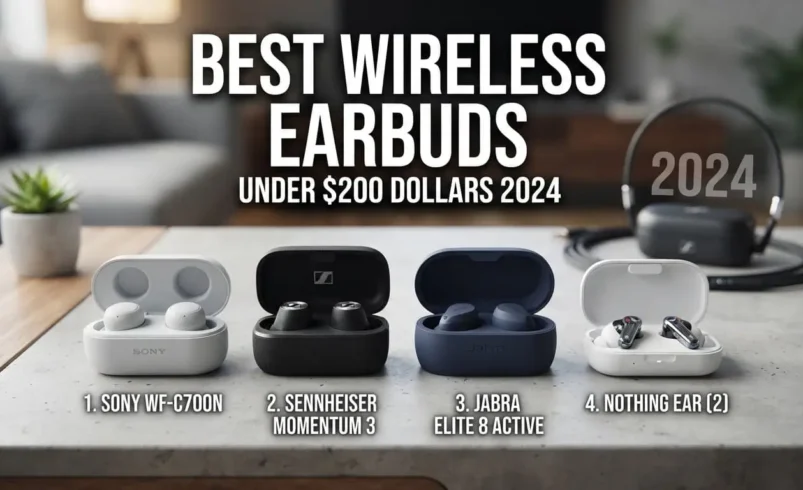
Best Wireless Earbuds Under 200 Dollars 2024: Top Picks and Buying Guide
November 24, 2026
0
Wireless earbuds became an increasingly capable everyday audio option in 2024. Buyers no longer had to spend several hundred dollars to get features such as active noise cancellation,
Wireless earbuds became an increasingly capable everyday audio option in 2024. Buyers no longer had to spend several hundred dollars to get features such as active noise cancellation, customizable sound, transparency modes, multipoint connectivity, and compact charging cases. The under-$200 category offered a particularly interesting mix: dependable everyday earbuds, feature-rich midrange models, and a few premium products that occasionally dropped below the $200 mark during promotions.
Choosing the right pair, however, involved more than comparing prices or looking at a manufacturer’s battery estimate. Some earbuds were better for commuting because of their noise cancellation, while others offered a more comfortable fit for long listening sessions. Smartphone compatibility also mattered: certain features worked best inside a particular brand’s ecosystem, and not every model offered the same call quality or control options.
This guide looks back at the 2024 market. It distinguishes products whose regular launch or retail pricing was below $200 from premium models that only sometimes entered that range through discounts. The aim is to explain what buyers could realistically expect, which compromises mattered, and how to choose earbuds for different listening habits.
Wireless earbuds under $200: 2024 comparison
The table uses U.S. launch or regular retail pricing where available, not today’s changing prices. Models that originally cost more than $200 are identified separately rather than being presented as standard under-$200 choices.
Earbuds Model
2024 Price
Best For
ANC
Battery
Main Advantage
Nothing Ear (2024)
$149
Balanced sound and customization
Yes
Up to 8.5 hrs / 40.5 hrs with case, ANC off
Detailed sound and app features
Soundcore Liberty 4 NC
$99.99
Noise cancellation on a budget
Yes
Up to 10 hrs / 50 hrs with case, ANC off
Strong feature set for the price
OnePlus Buds 3
$99
Everyday listening and Android users
Yes
Up to 10 hrs / 44 hrs with case, ANC off
Dual drivers and adaptive ANC
Beats Studio Buds +
$169.99
iPhone and Android users
Yes
Up to 9 hrs / 36 hrs with case, ANC off
Broad device compatibility
Google Pixel Buds Pro
$199
Pixel and Android users
Yes
Up to 11 hrs / 31 hrs with case, ANC off
Google integration and multipoint
EarFun Air Pro 3
Around $79.99–$99
Budget-conscious buyers
Yes
Up to 9 hrs / 45 hrs with case, ANC off
Useful features at a low price
Samsung Galaxy Buds2 Pro
$229.99 launch MSRP; sale-priced under $200 at times
Samsung Galaxy owners
Yes
Up to 8 hrs / 30 hrs with case, ANC off
Strong Samsung ecosystem features
Apple AirPods Pro 2 (USB-C)
$249 launch price; occasional sub-$200 sales
iPhone users seeking a premium option
Yes
Up to 6 hrs / 30 hrs with case, ANC off
Apple integration and polished controls
Battery figures are manufacturers’ maximum estimates and depend on settings, volume, codec, and other conditions. Samsung Galaxy Buds2 Pro and AirPods Pro 2 are included as sale-only comparisons: their original U.S. prices were above $200, so they were not regular-price under-$200 models. Nothing’s 2024 model launched at $149; OnePlus Buds 3 launched at $99; and the Pixel Buds Pro were introduced at $199. 【turn163233search0】【turn659678search6】【turn163233search1】
Understanding the wireless earbud market in 2024
The 2024 wireless earbud market had matured considerably. Active noise cancellation was no longer restricted to expensive flagship products, and many midrange models included companion apps, equalizer settings, multipoint connections, and quick charging. Buyers could choose between compact designs for commuting, bass-forward models for energetic music, and more customizable options for listeners who wanted to adjust their sound.
The biggest change was not simply that earbuds had become cheaper. It was that the differences between price categories had become more specific. A $100 pair might offer impressive battery life and useful ANC but have less refined call processing. A $150 model might deliver better sound customization, while a $200 option could provide stronger integration with a particular phone ecosystem.
That made the under-$200 category especially competitive. Rather than looking for one universal winner, buyers needed to identify which features mattered most to their daily routine.
What buyers could expect from a $200 budget
A $200 budget sat in a useful middle ground in 2024. It was enough for a well-equipped pair from a specialist audio brand or a premium-feeling model from a major phone manufacturer. Buyers could reasonably expect:
Active noise cancellation: Useful for reducing steady background sounds such as vehicle engines, air-conditioning, and general commuting noise.
Transparency mode: Microphones feed outside sound into the earbuds, allowing users to hear announcements or conversations without removing them.
Companion-app controls: Many models offered equalizers, listening modes, firmware updates, and customizable touch controls.
Charging cases: The case could provide multiple additional charges, making total battery life more important than the earbuds’ standalone runtime.
Multipoint connectivity: Selected models could remain connected to two devices, such as a phone and laptop.
Water resistance: Several options offered protection against sweat and splashes, although water resistance did not mean that the earbuds were suitable for swimming.
The compromises were usually found in the details. Microphone performance could vary considerably, ANC was not equally effective across models, and advertised battery figures were often measured under ideal conditions. Some advanced codecs and spatial-audio features also depended on having a compatible smartphone.
Important specifications that actually matter
Manufacturers list many technical details, but not all of them deserve equal attention. A buyer comparing earbuds should focus first on fit, sound, noise control, battery life, and compatibility.
Sound quality and audio codecs
The driver is the component that produces sound. Its size alone does not determine whether an earbud sounds good. Tuning, acoustic design, fit, and software processing all influence the result.
A balanced sound profile generally gives vocals, instruments, and bass room to work together. Bass-focused earbuds can make pop, hip-hop, and electronic music feel energetic, but excessive bass may cover detail in vocals or instruments. Listeners who enjoy acoustic music, podcasts, or classical recordings may prefer a more restrained presentation.
An equalizer, or EQ, allows users to adjust frequency ranges. It can make earbuds more flexible, especially when the default sound profile is not ideal.
Bluetooth codecs determine how audio is encoded and transmitted wirelessly. AAC and SBC are widely supported, while LDAC and LHDC can offer higher-bitrate options on compatible devices. A high-resolution codec does not automatically guarantee better sound: the source recording, fit, tuning, and the listener’s preferences still matter.
Active noise cancellation
Active noise cancellation uses microphones and processing to reduce unwanted external sound. It is especially useful for consistent low-frequency noise, such as the hum of an airplane cabin or a bus engine.
ANC is less reliable against sudden sounds and nearby conversations. A good physical seal from the ear tips is also important. Even advanced noise cancellation cannot fully compensate for earbuds that fit poorly.
Battery specifications are often presented in two ways: playback time from the earbuds themselves and total playback time including the charging case.
These figures should not be confused. A pair rated for eight hours in the earbuds and 32 hours with the case does not play for 32 continuous hours without being returned to the case.
ANC, high volume, spatial audio, and certain Bluetooth codecs can reduce runtime. Buyers who travel frequently should pay attention to the earbuds’ own listening time, not just the impressive combined figure.
Bluetooth and multipoint
Bluetooth is the wireless standard that allows earbuds to communicate with phones, tablets, laptops, and other compatible devices. The version number can indicate support for newer capabilities, but it does not independently guarantee better sound or a more stable connection in every situation.
Multipoint is particularly useful for people who use more than one device. It can allow earbuds to stay connected to a laptop and smartphone, making it easier to move between a video call and a phone call.
An IP rating describes protection against certain forms of dust or water exposure. For workout earbuds, sweat and splash resistance can be useful, but buyers should check the exact rating for the earbuds and charging case separately.
Water resistance is not permanent, and it does not mean a product can be submerged unless the manufacturer specifically states that it is designed for that use.
Detailed product analysis
1. Nothing Ear (2024): Best all-rounder for sound customization
Best overall balance
2024 launch price: $149
The Nothing Ear released in April 2024 and stood out because it offered a broad feature set without reaching the $200 ceiling. Its transparent styling gave it a distinctive appearance, but the more important attraction was its combination of sound customization, codec support, wireless charging, and everyday convenience. Its original U.S. price was $149. SoundGuys+1
Design and comfort: The compact, stem-style design was familiar, while the transparent finish made the earbuds visually different from many competitors. The lightweight construction helped with everyday wear, although comfort still depended on choosing the right silicone tip. A secure seal mattered for both bass response and noise isolation.
Audio performance: Sound quality was one of the main reasons to consider this model. Nothing provided app-based personalization and EQ controls, giving listeners more influence over the final sound. LDAC support was useful for compatible Android devices, although iPhone users would not gain the same codec benefit. The sound could be enjoyable and detailed, but the best settings depended on personal preference.
Noise cancellation: The earbuds included active noise cancellation and transparency mode. However, ANC was not the strongest reason to buy them. Reviews noted that noise cancellation could affect the sound balance, and its performance did not consistently match the best noise-cancelling competitors. SoundGuys+1
Battery and charging: Nothing rated the earbuds for up to 8.5 hours of playback without ANC and up to 40.5 hours with the case. With ANC enabled, its published estimates fell to around 5.2 hours for the earbuds and 24 hours including the case. Wireless charging added convenience for users who already had a compatible charging pad. NOTHING+1
Connectivity and additional features: Bluetooth 5.3, app-based customization, and support for modern audio codecs made the model flexible. Its feature set was especially attractive to Android listeners who wanted more control over sound.
Main advantages: Strong customization, attractive design, wireless charging, and a useful combination of features at $149.
Potential drawbacks: ANC was not class-leading, codec advantages varied by phone, and the fit needed to be right to get the best sound.
Who should consider it: Listeners who care about sound quality and personalization, especially Android users, could find the Nothing Ear a compelling 2024 choice. It was less suitable for someone whose first priority was the strongest possible noise cancellation.
2. Soundcore Liberty 4 NC: Best value for noise cancellation
2024 regular price: $99.99
Soundcore’s Liberty 4 NC demonstrated how much functionality buyers could get without spending close to $200. At its $99.99 launch price, it offered adaptive ANC, app-based sound customization, multipoint connectivity, wireless charging, and a long advertised battery life. soundcore+1
Design and comfort: The earbuds used a conventional in-ear design with silicone tips. The case was pocketable, and the earbuds were light enough for ordinary commuting and daily listening. As with any sealed in-ear model, tip selection made a noticeable difference to comfort and isolation.
Audio performance: The 11mm drivers delivered a lively presentation, and the companion app provided EQ and personalized sound options. LDAC support was a useful extra for compatible Android devices. Listeners who preferred a more neutral presentation could adjust the EQ rather than relying entirely on the factory tuning.
Noise cancellation: ANC was the headline feature. Soundcore used an adaptive system designed to adjust to surrounding noise and the listener’s ear. It could help reduce steady background sounds during travel or in a busy indoor environment. Its advertised noise-reduction percentage should not be interpreted as a guarantee that it would remove that proportion of every sound in real-world use.
Battery and charging: The company advertised up to 10 hours from the earbuds and 50 hours with the case when ANC was off. ANC use reduced those figures. The case supported wireless charging, and Soundcore also advertised quick charging for users who needed extra playback time in a hurry. Overview – soundcore US+1
Connectivity and additional features: Bluetooth 5.3, multipoint, IPX4 resistance, six microphones, and HearID customization made the Liberty 4 NC unusually feature-rich for its price.
Main advantages: Excellent feature-to-price balance, adaptive ANC, long advertised battery life, EQ options, and multipoint support.
Potential drawbacks: The sound profile might need adjustment for some listeners, and microphone performance in noisy surroundings could vary. Its larger feature list did not automatically make it the most comfortable choice for every ear shape.
Who should consider it: Commuters and budget-conscious buyers who wanted ANC and extensive app controls without spending $150 or more should have placed this model high on their 2024 shortlist.
3. OnePlus Buds 3: A strong everyday option
2024 launch price: $99
The OnePlus Buds 3 arrived in February 2024 with a $99 U.S. launch price. They offered dual dynamic drivers, adaptive noise cancellation, multipoint connectivity, and support for LHDC 5.0. Their feature set made them a particularly interesting option for Android users who wanted more than basic wireless audio. 9to5Google+1
Design and comfort: The stem-style design was lightweight, with each earbud weighing about 4.8 grams. The shape was intended for everyday listening, and the supplied silicone tips helped users find a suitable fit. Their IP55 rating gave the earbuds better dust and water protection than some basic splash-resistant alternatives.
Audio performance: OnePlus used a 10.4mm woofer and a 6mm tweeter in each earbud. This dual-driver arrangement helped separate lower and higher frequencies. The default sound leaned toward energetic bass, which suited many modern music styles, although listeners who preferred a flatter profile might want to adjust the EQ.
Noise cancellation: Smart adaptive ANC was rated for up to 49dB of noise reduction under the manufacturer’s testing conditions. The earbuds also provided transparency mode, allowing outside sound to be heard when needed. As with other ANC models, actual results depended on fit and the type of surrounding noise.
Battery and charging: OnePlus advertised up to 10 hours of playback from the earbuds and 44 hours with the case when ANC was off. With ANC or transparency enabled, the stated estimates were up to 6.5 hours and 28 hours respectively. Fast charging was another useful feature for people who regularly forgot to charge their case. OnePlus+1
Connectivity and additional features: Bluetooth 5.3, Google Fast Pair, dual-device connection, and LHDC support gave the Buds 3 a strong specification sheet. Some features were more useful when paired with compatible Android phones, but basic Bluetooth playback was not restricted to OnePlus devices.
Main advantages: Competitive price, dual drivers, strong feature set, adaptive ANC, and a comfortable lightweight design.
Potential drawbacks: The bass-heavy tuning would not suit every listener, and actual battery performance could be shorter than the headline estimates. Some advanced features depended on compatible devices.
Who should consider it: The OnePlus Buds 3 were a sensible everyday choice for Android users, especially those who wanted ANC, multipoint, and a lively sound without using most of their budget.
4. Beats Studio Buds +: A flexible choice for iPhone and Android
2024 regular price: $169.99
The Beats Studio Buds + were already available before 2024 and remained a relevant option during that year. Their $169.99 standard price placed them comfortably below the $200 limit. Unlike some earbuds that concentrated on a single phone ecosystem, Beats designed this model to work with both Apple and Android devices. Apple+1
Design and comfort: The compact earbuds had a familiar in-ear shape and came with four sizes of silicone tips, including an extra-small option. That additional size choice could help people who struggled with the fit of standard earbuds. The transparent finish also offered a distinctive alternative to conventional black or white designs.
Audio performance: Beats tuned the Studio Buds + for an energetic, accessible sound. Their presentation suited popular music, podcasts, and everyday entertainment. The design included improved acoustic venting and a revised transducer system intended to deliver cleaner bass and reduce distortion.
Noise cancellation: ANC and transparency modes were both included. Noise cancellation was useful for general travel and indoor environments, although buyers should not assume it matched the performance of more expensive flagship earbuds. The physical fit remained important to overall isolation.
Battery and charging: Beats advertised up to nine hours of listening time from the earbuds and up to 36 hours with the case when ANC and transparency were off. Using listening modes reduced battery life. The case charged through USB-C, but wireless charging was not one of the model’s headline conveniences. Beats+1
Connectivity and additional features: The Studio Buds + supported Apple and Android devices, with platform-specific conveniences available through the relevant operating systems. Physical button controls were useful for people who preferred a definite click rather than touch-sensitive surfaces.
Main advantages: Broad device compatibility, compact design, four ear-tip sizes, useful battery estimates, and a recognizable sound profile.
Potential drawbacks: The model did not provide every advanced Apple ecosystem feature found on AirPods Pro 2. It also lacked some conveniences, such as wireless charging, that buyers could find elsewhere in the price category.
Who should consider it: People who regularly switch between iPhone, Android, tablets, or computers could appreciate the Studio Buds +. They were also worth considering for listeners who preferred physical controls and a compact design.
5. Google Pixel Buds Pro: Best for Google and Android integration
2024 regular price: $199
The original Pixel Buds Pro launched at $199, putting it at the upper edge of this guide’s budget. By 2024, it remained an option for people who wanted Google’s software integration, ANC, multipoint, and wireless charging. Google introduced the model as its first Pixel Buds product with active noise cancellation. blog.google+1
Design and comfort: The earbuds had a rounded shape with silicone tips and an active pressure-relief system intended to reduce the plugged-ear sensation. Fit was personal, however, and the design could feel bulkier than some lighter alternatives.
Audio performance: The Pixel Buds Pro used 11mm custom-designed drivers. Their sound had a noticeable low-frequency presence, which suited pop and rock listening. Google later expanded software features, including sound adjustments, making the model more flexible than it was at its initial launch.
Noise cancellation: ANC was a major part of the Pixel Buds Pro experience. Google’s Silent Seal technology was designed to adapt to the listener’s ear shape and improve the seal. This could help reduce outside noise, although the effectiveness still depended on selecting the correct ear tips.
Battery and charging: Google’s original estimates were up to 11 hours without ANC and up to seven hours with ANC enabled. Combined with the case, the company listed up to 31 hours without ANC and 20 hours with ANC. The case supported both USB-C and wireless charging. blog.google+1
Connectivity and additional features: Multipoint, Google Assistant integration, and Pixel-friendly software features made the earbuds particularly attractive to Android users. They could also connect to other Bluetooth devices, although some conveniences were more closely tied to Google’s ecosystem.
Main advantages: Strong Android integration, useful ANC, wireless charging, multipoint, and a good advertised battery life.
Potential drawbacks: The original model was nearing the $200 ceiling, and its shape might not suit every listener. Some software conveniences were more useful with compatible Android devices than with an iPhone.
Who should consider it: Pixel owners and Android users who wanted a comfortable set of smart features and reliable everyday functionality could find the Pixel Buds Pro a strong 2024 choice.
6. EarFun Air Pro 3: Best budget-friendly feature set
2024 typical price: approximately $79.99–$99
The EarFun Air Pro 3 was not a new 2024 release, but it remained relevant as a value-oriented choice. Its original launch price was around $99, while the model was also commonly listed at lower prices. It combined ANC, wireless charging, multipoint, and a six-microphone call system at a budget-friendly level. EarFun+1
Design and comfort: The Air Pro 3 used a conventional stem design and weighed around 5.2 grams per earbud. Multiple ear-tip sizes helped users find a secure fit. The IPX5 rating made the earbuds suitable for ordinary sweat and splash exposure, although the case did not share the same rating.
Audio performance: Its 11mm wool-composite drivers produced a full, accessible sound. The earbuds supported aptX Adaptive on compatible devices, which could be useful for listeners with phones that supported the codec. The companion app offered additional control, but the sound quality was not necessarily as refined as more expensive models.
Noise cancellation: QuietSmart 2.0 hybrid ANC was designed to reduce background noise. It was a helpful addition at this price, but it should be viewed as practical budget noise control rather than premium-level isolation. Some independent reviews found its ANC less impressive than the marketing language suggested. shop.myearfun.com+1
Battery and charging: EarFun advertised up to nine hours of playback from the earbuds and up to 45 hours with the case when ANC was off. The company also listed wireless charging and quick-charge support. Actual results depended on listening volume and enabled features. EarFun+1
Connectivity and additional features: Bluetooth 5.3, multipoint, aptX Adaptive, and app support made the model flexible for its price. Its six microphones were intended to improve call clarity.
Main advantages: Affordable pricing, ANC, multipoint, wireless charging, and a generous advertised battery estimate.
Potential drawbacks: ANC and overall sound refinement were not on the same level as stronger midrange alternatives. The model’s age also meant that buyers needed to compare its price carefully against newer options available in 2024.
Who should consider it: Buyers who wanted useful features at a lower price and did not need flagship sound or noise cancellation could find the EarFun Air Pro 3 worthwhile.
7. Samsung Galaxy Buds2 Pro: A premium model worth watching on sale
Original launch price: $229.99; under $200 only when discounted
The Galaxy Buds2 Pro launched above the $200 threshold, so it was not a regular-price recommendation for this guide. However, discounts made it a relevant comparison for shoppers willing to wait for a promotion. It offered a compact design, ANC, IPX7-rated earbuds, and Samsung-specific audio features. Android Authority+1
Design and comfort: The small, rounded earbuds were designed to sit securely inside the ear without a long stem. Their compact shape appealed to users who preferred a discreet look. Comfort still depended on the ear-tip seal, particularly during longer sessions.
Audio performance: Samsung offered a dual-driver arrangement and support for its own high-quality audio features on compatible Galaxy devices. The sound was detailed and energetic, and the model supported Samsung’s 360 Audio feature.
Noise cancellation: ANC was included and could reduce a range of everyday background sounds. Its performance was a strong part of the overall package, although buyers should remember that the best results depended on a good fit.
Battery and charging: Samsung’s published estimates were up to five hours of playback with ANC enabled and up to 18 hours including the case. With ANC off, the estimates rose to eight hours from the earbuds and 30 hours with the case. Wireless charging and USB-C were supported. Android Authority
Connectivity and additional features: The Buds2 Pro used Bluetooth 5.3 and offered Samsung ecosystem conveniences, including features that worked best with compatible Galaxy devices. They could connect to other Bluetooth phones, but not every Samsung-specific feature carried over.
Main advantages: Compact design, useful ANC, IPX7-rated earbuds, and strong integration with Samsung phones.
Potential drawbacks: Its original price exceeded the budget, battery life with ANC was moderate, and several advanced features were tied to Samsung devices.
Who should consider it: Samsung Galaxy owners who found the Buds2 Pro discounted below $200 could have considered them a strong sale purchase. At full launch price, they belonged in a higher price category.
8. Apple AirPods Pro 2: A sale-only premium option for iPhone users
2024 standard price: $249; under $200 only during qualifying sales
The USB-C version of AirPods Pro 2 was priced at $249 when introduced in 2023. That placed it outside the standard under-$200 category in 2024. However, retail promotions sometimes made it relevant to shoppers who could find a verified discount. Apple+1
Design and comfort: The familiar short-stem design included silicone tips in multiple sizes. The fit test available through Apple devices helped users check whether they had selected an appropriate tip. The earbuds were compact, and the charging case included features designed to make it easier to locate.
Audio performance: Apple’s H2 chip supported adaptive audio processing, personalized spatial audio, and other software-driven features. The overall presentation was balanced and accessible, making the earbuds suitable for different music styles, podcasts, and calls.
Noise cancellation: ANC was one of the strongest reasons to consider this model. Transparency mode was also a major strength, allowing outside sound to pass through in a more natural way. Adaptive Audio combined aspects of noise cancellation and transparency to respond to changing surroundings.
Battery and charging: Apple rated the earbuds for up to six hours of listening on a single charge under its stated test conditions, with up to 30 hours available using the charging case. The USB-C case supported convenient charging options. Apple Support
Connectivity and additional features: The AirPods Pro 2 were particularly well integrated with Apple devices. Automatic switching, Siri support, spatial audio, and other software features made them more convenient for people who already used an iPhone, iPad, or Mac.
Main advantages: Excellent Apple integration, effective ANC, polished transparency, and a strong overall feature set.
Potential drawbacks: The $249 standard price exceeded the budget, and several conveniences were designed primarily for Apple users. Buyers using Android would lose much of the ecosystem advantage.
Who should consider it: iPhone owners who found the USB-C AirPods Pro 2 below $200 during a genuine sale could have considered them a premium bargain. They should not be described as a regular-price under-$200 model.
Which earbuds suited different types of listeners?
The strongest model on a specification sheet is not automatically the best choice for every person. A commuter, an iPhone owner, a gym user, and someone who listens to music at a desk may need very different things.
Listener type
Models worth considering
Why they may fit
Frequent commuter
Soundcore Liberty 4 NC, Pixel Buds Pro
ANC and useful everyday controls
Sound customization enthusiast
Nothing Ear (2024)
EQ, personalization, and codec options
OnePlus or Android user
OnePlus Buds 3
Android-friendly features and multipoint
iPhone and Android switcher
Beats Studio Buds +
Broad compatibility
Samsung Galaxy owner
Galaxy Buds2 Pro on sale
Samsung ecosystem features
Budget buyer
EarFun Air Pro 3, Soundcore Liberty 4 NC
Useful features at a lower cost
iPhone owner seeking premium features
AirPods Pro 2 on sale
Apple integration and listening modes
For commuting and travel
Noise cancellation should be a major consideration if earbuds will be used on buses, trains, or flights. Soundcore Liberty 4 NC and Google Pixel Buds Pro were useful options in this context because both combined ANC with practical everyday features. The Nothing Ear was also capable, but it was more compelling for its sound customization than for class-leading isolation.
A secure fit is just as important as ANC. If the ear tips do not seal properly, low-frequency noise can leak in and music may sound thinner. Buyers should test the supplied tip sizes rather than assuming that the medium option will work.
For calls, online classes, and meetings
Microphone quality is not always reflected by the number of microphones listed on the box. The design of the microphones, wind handling, and software processing all affect how a person’s voice sounds to someone else.
The Beats Studio Buds + and Soundcore Liberty 4 NC included multi-microphone systems, while the OnePlus Buds 3 also offered several microphones per side. These specifications were useful, but people who regularly attended important meetings should still look for independent call-quality comparisons. A headset designed specifically for professional calls may be more suitable than music-focused earbuds.
For iPhone users
AirPods Pro 2 were the most integrated option for iPhone owners, but their regular price was above the budget. Beats Studio Buds + offered a more affordable Apple-friendly alternative and also worked with Android phones.
Nothing Ear and other Bluetooth models could play audio from an iPhone, but advanced codec support and some app features varied by device. Buyers should distinguish between basic compatibility and full feature support.
For Android users
Android buyers had several strong choices. OnePlus Buds 3, Nothing Ear, Soundcore Liberty 4 NC, and Pixel Buds Pro all offered useful Android-oriented features. The best match depended on the phone brand, codec support, and whether the user valued multipoint, EQ, ANC, or ecosystem convenience most.
For exercise and outdoor use
Workout buyers should focus on stability, comfort, and water-resistance ratings. The OnePlus Buds 3 had an IP55 rating, while the Soundcore Liberty 4 NC and Beats Studio Buds + offered IPX4 protection. EarFun Air Pro 3 had an IPX5 rating. These ratings describe resistance under specified test conditions, not permission to swim or expose the earbuds to unlimited water.
A good workout fit should remain secure during ordinary movement without requiring constant adjustment. If a pair feels uncomfortable during a short trial, it is unlikely to become a good choice for longer sessions.
Common purchasing mistakes to avoid
Choosing by ANC claims alone
Manufacturers sometimes advertise large noise-reduction figures. These numbers may be measured under specific conditions and should not be treated as a direct comparison across different brands.
Real-world performance depends on the type of sound, ear-tip seal, fit, and software. Independent reviews and practical listening comparisons are more useful than a single headline number.
Assuming bigger drivers always sound better
Driver size is only one part of an earbud’s audio design. A larger driver does not guarantee clearer vocals, better bass, or a more natural sound. Tuning and fit are equally important.
Confusing total battery life with single-charge battery life
A claim of 40 or 50 hours usually includes the charging case. Someone who uses earbuds for long stretches without access to the case should prioritize the standalone listening estimate.
Ignoring comfort
A technically impressive pair can become frustrating if it creates pressure or does not stay in place. Ear shape varies, so reviews cannot guarantee that a particular model will fit everyone.
Overlooking smartphone compatibility
Some features depend on a specific phone or operating system. High-quality codecs, spatial audio, automatic switching, and voice assistant integration may not work identically across devices.
Buying an old model without checking its condition
When considering a 2024 model today, check whether it is new, refurbished, or used. Battery cells gradually lose capacity, and older stock may have been stored for a long period. Warranty coverage, return policies, and seller reputation matter just as much as the discount.
Are 2024 wireless earbuds still worth considering today?
A model released in 2024 can still be useful, but its age changes the buying decision. Newer products may offer improved processing, more recent Bluetooth features, updated apps, or better battery efficiency. That does not automatically make every older pair obsolete.
The Nothing Ear, OnePlus Buds 3, Soundcore Liberty 4 NC, and Beats Studio Buds + had feature sets that were competitive for their original price categories. They can remain sensible purchases when sold at an attractive price by a reputable retailer and supported by a valid warranty.
There are, however, reasons to be cautious. A model may have been replaced by a newer generation, and its remaining stock could be limited. Some products may no longer receive frequent firmware updates. Battery performance in old or used units can also differ from the original published estimates.
A buyer in 2026 should therefore treat the 2024 price as historical context, not as a guarantee of today’s value. Compare the actual price against current alternatives, verify the exact model number, and check whether the manufacturer still provides software and warranty support.
Final buying advice: Match the earbuds to your routine
The best wireless earbuds under $200 in 2024 were not defined by one specification or brand. They represented different approaches to value.
The Nothing Ear (2024) offered an appealing balance of sound quality and customization at $149. Soundcore Liberty 4 NC delivered an unusually extensive feature set at $99.99, making it a strong value option for people who wanted ANC. OnePlus Buds 3 combined dual drivers, adaptive noise cancellation, and Android-friendly features for $99. Beats Studio Buds + offered broad compatibility at $169.99, while Google’s Pixel Buds Pro reached the $199 limit with useful software integration.
Samsung Galaxy Buds2 Pro and Apple AirPods Pro 2 deserved attention only when a genuine discount brought them below $200. Their original standard prices were higher, so presenting them as ordinary sub-$200 products would give buyers the wrong impression.
For most people, the smartest purchase starts with three questions: Which phone will the earbuds connect to? Where will they be used most often? And which matters more: sound quality, noise cancellation, comfort, calls, or battery life?
Answering those questions makes it easier to narrow the options. A commuter may prioritize ANC, a music enthusiast may prefer sound customization, and an iPhone owner may value seamless device integration. Someone who exercises regularly may care more about fit and water resistance than advanced audio codecs.
A well-chosen pair should feel comfortable, connect reliably, sound enjoyable, and suit the places where it will be used. That practical combination—not the longest specification list—is what made the best wireless earbuds under $200 in 2024 worth considering.
FAQs About Best Wireless Earbuds Under 200 Dollars 2024
Strong regular-price options included Nothing Ear (2024), Soundcore Liberty 4 NC, OnePlus Buds 3, Beats Studio Buds +, Google Pixel Buds Pro, and EarFun Air Pro 3. They served different priorities: Nothing emphasized customization, Soundcore offered value and ANC, OnePlus delivered a feature-rich everyday package, and Beats provided broad device compatibility. Pixel Buds Pro were especially attractive to Android users.
2. Which models offered the best noise cancellation?
Soundcore Liberty 4 NC and Google Pixel Buds Pro were compelling options for buyers who wanted ANC without exceeding $200 at regular pricing. Nothing Ear (2024) also included ANC, but its strongest appeal was sound customization. AirPods Pro 2 and Samsung Galaxy Buds2 Pro could be attractive on sale, although their original prices were above the budget.
3. Which earbuds were suitable for everyday use?
Nothing Ear, OnePlus Buds 3, Beats Studio Buds +, and Soundcore Liberty 4 NC were all reasonable everyday options. Comfort, controls, charging convenience, and device compatibility mattered as much as sound. The best choice depended on whether the listener spent more time commuting, taking calls, studying, exercising, or listening at home.
4. Which options worked particularly well with iPhones?
AirPods Pro 2 offered the most complete integration with Apple’s ecosystem, but their standard price was $249. Beats Studio Buds + were a more budget-friendly option with support for both Apple and Android devices. Other Bluetooth earbuds could play audio from an iPhone, but some advanced codec or ecosystem features might not be available.
5. What features mattered most when buying wireless earbuds?
Fit and comfort should come first because they affect both listening quality and long-term usability. After that, buyers should consider sound tuning, ANC, transparency mode, microphone performance, battery life, charging, water resistance, and device compatibility. A feature is only valuable if it works reliably with the listener’s phone and daily routine.
6. Were premium features available below $200?
Yes. In 2024, many models under $200 included active noise cancellation, transparency modes, EQ customization, multipoint connectivity, wireless charging, and fast charging. The main differences from more expensive flagship models were often the strength of ANC, call quality, build refinement, ecosystem integration, and advanced audio features.
7. How important was battery performance?
Battery life was important for commuters, travelers, and people who used earbuds throughout the day. Buyers needed to compare standalone playback time with total case-supported runtime and remember that ANC, high volume, and certain codecs could reduce battery life. A pair with a smaller headline total could still be more practical if its earbuds lasted longer between charges.
8. Are 2024 wireless earbuds still worth buying?
They can be, particularly when sold new at a meaningful discount with reliable warranty coverage. Models such as the Nothing Ear, OnePlus Buds 3, and Soundcore Liberty 4 NC offered useful features at their original prices. Before buying today, check current alternatives, battery condition if refurbished, software support, and whether the seller is reputable.
9. Is Bluetooth version the most important specification?
No. Bluetooth version can indicate support for newer wireless capabilities, but it does not independently determine sound quality or connection stability. Codec support, phone compatibility, antenna design, software, and the surrounding wireless environment also matter. Buyers should focus on how well the earbuds work with their own devices.
10. Should I buy earbuds with the highest advertised battery life?
Not necessarily. Battery estimates are measured under particular conditions and can vary with volume, ANC, codec, and usage. A pair with excellent case-supported runtime may still have a relatively short standalone listening time. Choose a model whose real-world battery pattern fits how long you typically listen between charges.