RN Fundamentals 2016: Why Nursing Knowledge Matters Beyond the Assessment
November 28, 2026
0
Nursing education is built around a principle that remains important regardless of examination dates, course editions, or changes in assessment technology: safe patient care depends on a strong
Nursing education is built around a principle that remains important regardless of examination dates, course editions, or changes in assessment technology: safe patient care depends on a strong understanding of fundamental nursing concepts. Before nursing students can develop advanced clinical skills, they need to understand how to observe patients, communicate clearly, prevent avoidable harm, recognize changing needs, and make decisions within their professional responsibilities.
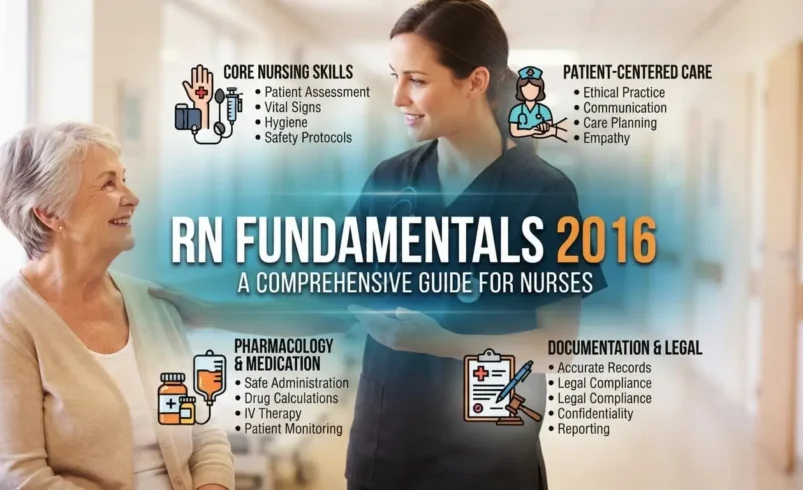
This is the educational context in which RN Fundamentals 2016 should be understood. The phrase is associated with ATI nursing education materials and historical assessments designed to evaluate students’ understanding of foundational nursing practice. It is also used in searches for older practice materials, assessment formats, and study resources.
However, an important distinction is frequently overlooked. ATI RN Fundamentals Online Practice 2016 B and the RN Fundamentals 2016 proctored assessment are not interchangeable names for one test. ATI’s historical product listing describes the online Practice 2016 B assessment as a 60-item test containing rationales. Separately, nursing-program documentation identifies a 70-item proctored assessment in the context of its particular assessment arrangements. These figures refer to different assessment contexts and should not be combined into a single question count.
The difference matters, but the educational purpose reaches much further than the number of questions. Nursing fundamentals connect classroom learning with the responsibilities of patient care. They help students understand why an observation matters, why a safety procedure exists, how communication affects care, and why clinical decisions must be based on more than memorized information.
The central question is therefore worth examining beyond the historical assessment itself: Why do nursing fundamentals remain important beyond a particular assessment year?
RN Fundamentals 2016: An Educational Overview
The following table summarises the assessment’s historical context while separating established details from information that should not be assumed.
Fact
Details
Assessment Name
RN Fundamentals 2016
Subject Area
Foundational registered nursing knowledge and basic nursing practice
Associated Organization
Assessment Technologies Institute (ATI), in relation to its RN Fundamentals educational products
Assessment Version
Historical 2016 assessment materials; the exact form depends on the product or institutional assessment
Historical Question Count
Online Practice 2016 B: 60 items. A separate nursing-program document identifies a 70-item proctored assessment in its particular context
Assessment Type
Includes online practice assessments and separate proctored assessments
Core Nursing Concepts
Foundations of practice, basic nursing care, psychosocial needs, physiological needs, health assessment, safety, communication, and infection prevention
Educational Purpose
To evaluate or strengthen students’ understanding of fundamental nursing concepts
Intended Learners
Registered nursing students and learners studying foundational nursing content
Relationship to NCLEX Preparation
Supports foundational knowledge relevant to nursing education and preparation, but is not itself an NCLEX examination
Historical Relevance
Provides a reference point for understanding an earlier ATI assessment and nursing education framework
Current Study Considerations
Use current course materials, institutional guidance, contemporary clinical references, and updated assessment information
The question-count distinction deserves particular attention. ATI’s historical product listing explicitly describes RN Fundamentals Online Practice 2016 B as a 60-item test. A separate proctored assessment should be identified by its own documentation and administration details. A 70-item figure from a nursing-program document should not be transferred to the online practice product, nor should the online practice count be used to describe every proctored assessment.
The Educational Background Behind RN Fundamentals 2016
Understanding the ATI connection
Assessment Technologies Institute, commonly known as ATI, is associated with nursing education resources and assessment products used by nursing programs. Its educational materials have included subject-specific practice assessments, proctored assessments, learning resources, and performance feedback.
The RN Fundamentals 2016 materials belong to this wider educational environment. Their subject matter reflects the importance of preparing students to understand basic nursing responsibilities before progressing towards more complex clinical situations.
Fundamentals is a particularly important area because it connects several parts of nursing education. Students learn about patient assessment, communication, infection prevention, personal care, safety, physiological needs, and professional standards. These subjects are not isolated academic topics. They influence one another during ordinary patient care.
For example, understanding a patient’s basic needs involves more than recognising a clinical term. A student must also appreciate the importance of observation, privacy, communication, documentation, and appropriate escalation when a patient’s condition changes.
Why historical assessment materials still attract attention
Older nursing assessments remain a subject of interest for several reasons. Students may encounter references to a particular assessment year in course documents, study notes, institutional records, or online educational discussions.
Some learners want to understand the structure of an earlier assessment. Others want to review the concepts associated with it or compare historical learning materials with current course expectations.
The year 2016 is therefore part of the assessment’s historical identity. It does not mean that every nursing principle covered in the material has become outdated. Nor does it mean that the exact assessment structure, scoring arrangements, or content distribution should be assumed to remain current.
The most useful approach is to separate the enduring nursing concepts from the historical details of the assessment.
Why Nursing Fundamentals Are Assessed
Fundamental nursing knowledge is assessed because it provides the basis for safe and organised care. A student may remember terminology but still struggle to apply it when a patient has several needs at once. Assessment helps educators examine whether learners can connect concepts with appropriate nursing decisions.
Moving from memorization to understanding
Memorization has a place in nursing education. Students need to learn terminology, basic procedures, professional concepts, and important reference information.
However, memorization alone cannot demonstrate clinical understanding.
A learner may remember that patient assessment involves collecting information, but a deeper understanding includes recognizing why information should be accurate, relevant, organized, and documented. The learner must also understand that observations need to be interpreted in context rather than considered as unrelated facts.
This is why nursing assessment preparation should focus on the reasoning behind a concept.
When a student understands why a nursing principle matters, that knowledge is more adaptable. It can be applied to different patient situations instead of being limited to one familiar question.
Connecting theory with patient care
Nursing education includes classroom instruction, reading, laboratory practice, simulation, supervised clinical learning, and assessment. Each setting contributes something different.
Classroom learning introduces concepts. Laboratory activities help students understand practical skills. Simulation allows learners to consider decisions in structured situations. Clinical learning connects these experiences with the complexity of real healthcare environments under appropriate supervision.
An assessment such as RN Fundamentals 2016 belongs within this wider learning process. Its value is not simply whether a student can complete a particular test. Its educational relevance comes from the foundational knowledge it encourages students to develop.
The Main Areas of Nursing Knowledge
The historical ATI RN Fundamentals Online Practice 2016 B product description identifies several broad areas of nursing knowledge. These include foundations of practice, basic nursing care, psychosocial needs, physiological needs, and health assessment.
Together, these areas provide a useful picture of the breadth of nursing fundamentals.
Foundations of practice
Foundations of practice concern the principles that guide nursing responsibilities.
This area includes the healthcare environment, communication, professional standards, thinking strategies, nursing through the lifespan, and health assessment.
Students need to understand that nursing is not simply a collection of tasks. It is a professional practice involving observation, informed decisions, communication, accountability, and respect for individual needs.
Professional standards also help define the boundaries of nursing responsibilities. Students should understand that they must work within their education, authorization, supervision arrangements, and applicable professional requirements.
Basic nursing care
Basic nursing care focuses on the everyday needs of patients.
Historical ATI descriptions include topics such as admission, transfer, and discharge processes; medication administration and error prevention; safety; infection control; comfort; basic needs; and wound care.
These subjects may appear straightforward, but they involve important decisions.
A patient’s comfort, mobility, hygiene, nutrition, privacy, and ability to participate in daily activities can affect the overall experience of care. Nursing students therefore need to understand how basic care contributes to dignity, wellbeing, and safety.
The concept of basic care should never be confused with unimportant care. Fundamental responsibilities often provide the foundation for more advanced nursing interventions.
Psychosocial needs
Patients have emotional, social, cultural, family, and spiritual needs in addition to physical healthcare needs.
Psychosocial nursing knowledge helps students recognize that illness can affect confidence, relationships, routines, independence, and emotional wellbeing.
A patient may be worried about a diagnosis, uncertain about a treatment plan, or concerned about the effect of illness on family responsibilities. These experiences can influence how the patient communicates and participates in care.
Nurses should approach such concerns with respect and avoid making assumptions about a person’s beliefs, background, or preferences.
The educational emphasis is on understanding the whole person rather than treating a diagnosis as the patient’s complete identity.
Physiological needs
Physiological needs involve the body’s basic functions and the systems that support life.
Fundamental nursing education may introduce oxygenation, circulation, fluid balance, electrolyte balance, acid-base concepts, gastrointestinal function, elimination, and neurosensory needs.
Students learn the terminology and relationships involved in these systems so they can understand patient observations and recognize when further assessment is necessary.
The value of this knowledge becomes clearer when several observations must be considered together. A single finding may have a different meaning depending on the patient’s history, other observations, and overall condition.
Health assessment
Health assessment is a central part of nursing fundamentals because it provides information about a patient’s condition and needs.
Students learn about collecting relevant information, observing patients, understanding vital signs, and considering general and system-specific assessment findings.
Assessment is not simply a process of recording numbers. It requires attention to the patient, awareness of the context, and accurate communication of relevant findings.
A strong foundation in assessment helps learners understand why changes should be noticed, documented, and communicated appropriately.
Patient Safety: The Principle Behind Everyday Nursing Practice
Patient safety is not a single chapter within nursing education. It is a responsibility that influences almost every part of patient care.
A student studying RN Fundamentals 2016 should understand that safety principles apply during communication, patient identification, infection prevention, medication-related responsibilities, mobility assistance, documentation, and many other aspects of care.
Safety as a continuous responsibility
Safe care requires attention before, during, and after an activity.
A nursing student must understand the importance of following institutional procedures, checking relevant information, communicating concerns, and seeking appropriate guidance when something is unclear.
The educational goal is not to encourage independent action beyond a learner’s responsibilities. It is to develop awareness of risk, professional accountability, and the importance of following approved standards.
Infection prevention and control
Infection prevention is a fundamental component of healthcare education.
Students learn why healthcare environments require appropriate hygiene practices, infection-control procedures, and attention to the prevention of cross-contamination.
These principles protect patients, healthcare workers, and others who enter clinical environments.
The exact procedures used in a particular setting should follow current institutional policies and applicable healthcare guidance. Historical assessment material can introduce the underlying concepts, but students should not treat an older resource as a substitute for current infection-prevention requirements.
Medication safety and professional responsibility
Medication-related knowledge is another important part of basic nursing education.
Students need to understand that medication administration involves professional responsibility, accurate information, appropriate authorization, and established safety processes.
The educational emphasis should be on understanding why safeguards exist rather than memorizing isolated statements.
Medication practices can change as regulations, institutional policies, and clinical guidance develop. Learners should therefore use current course references and supervised instruction when studying medication-related responsibilities.
Health Assessment and the Importance of Clinical Observation
A patient cannot be understood through one observation alone.
Health assessment requires students to consider information from several sources, including patient communication, visible signs, reported symptoms, relevant history, and measured observations.
Recognizing patterns rather than isolated details
Clinical observation becomes more meaningful when students learn to consider patterns.
For example, a change in a patient’s general presentation may need to be understood alongside other relevant observations and the patient’s reported experience.
The educational point is that nurses should not automatically treat every finding as independent of the wider situation.
Students must develop the ability to recognize when information needs clarification, additional assessment, or communication with an appropriate member of the healthcare team.
Accurate and objective documentation
Documentation provides a record of relevant care and observations.
Students should understand the difference between recording what was observed or reported and adding unsupported personal interpretations.
Clear documentation helps maintain continuity of care and supports communication between members of the healthcare team.
It should be accurate, timely, appropriate to the situation, and consistent with the requirements of the relevant institution and professional standards.
Therapeutic Communication Is Part of Clinical Knowledge
Communication is sometimes treated as a separate soft skill, but it is closely connected with safe nursing practice.
A patient may have difficulty explaining a concern, understanding information, or expressing a preference. A nurse’s communication approach can influence whether the patient feels heard and whether relevant information is gathered accurately.
Listening and respect
Therapeutic communication involves listening carefully, responding respectfully, and avoiding unnecessary judgment.
Students should understand that patients may have different communication needs, levels of health literacy, cultural preferences, and emotional responses.
A clear explanation should be appropriate to the patient’s circumstances rather than relying on technical language that may create confusion.
Communication within the healthcare team
Nursing also involves communicating with colleagues and other healthcare professionals.
Important information needs to be shared accurately and through appropriate channels. Students should learn why clarity, professional language, and timely communication matter.
The goal is to support continuity of care and reduce the risk of misunderstandings.
Communication is therefore not simply about speaking politely. It is part of gathering information, supporting patients, documenting care, and coordinating professional responsibilities.
Psychosocial and Physiological Needs Must Be Considered Together
A common misunderstanding in early nursing education is that physical and emotional needs can be treated as completely separate areas.
In practice, they influence one another.
A patient’s physical condition may affect mood, confidence, independence, and social participation. Emotional distress may also influence how a person communicates symptoms or engages with healthcare.
Understanding the whole patient
A person receiving care is more than a diagnosis or a set of observations.
Nursing fundamentals encourage students to consider individual needs, preferences, communication, dignity, family circumstances, and physical wellbeing.
This approach supports person-centred care, in which the patient’s perspective is treated as an important part of the healthcare relationship.
Respecting individual differences
Patients may have different cultural, spiritual, family, and personal preferences.
Students should avoid assuming that one approach will be suitable for everyone. Respectful nursing practice involves asking appropriate questions, listening, and following relevant professional guidance.
This is one reason psychosocial concepts remain important in nursing education. They help learners understand that safe care also requires respect for individual identity and circumstances.
Clinical Judgment: Turning Knowledge Into Reasoned Decisions
Clinical judgment is one of the most important ideas connecting nursing fundamentals with professional practice.
It involves using relevant information, nursing knowledge, observation, and reasoning to understand a situation and determine what requires attention.
Why clinical reasoning cannot be reduced to memorization
Memorized facts can help students recognize terminology and basic principles. However, a clinical situation may involve several pieces of information that need to be considered together.
A student must understand which details are relevant, what remains uncertain, and when an issue needs to be communicated to a qualified supervisor or healthcare professional.
This process requires more than remembering a preferred answer.
Prioritization and patient needs
Nursing students also learn that not every task has the same urgency.
Prioritization involves considering the patient’s condition, immediate needs, safety, and the responsibilities of the healthcare team.
The educational principle is that decisions should be guided by relevant assessment information and established professional standards, not by guesswork or a rigid memorized order.
Learning from the rationale
A rationale explains why an answer or decision is appropriate within a particular educational scenario.
Reviewing rationales can help students identify the principle being tested, understand why other approaches may be less suitable, and recognize the limits of the example.
This makes rationales valuable learning tools. They encourage students to examine the reasoning behind an answer instead of focusing only on whether a response was marked correct.
Understanding the Difference Between Online Practice and Proctored Assessments
The question-count confusion surrounding RN Fundamentals 2016 shows why assessment labels must be read carefully.
ATI has provided separate online practice and proctored assessment products. They serve related but different educational purposes.
RN Fundamentals Online Practice 2016 B
ATI’s historical product listing describes RN Fundamentals Online Practice 2016 B as a 60-item test.
The listing states that it includes rationales and evaluates students’ understanding of fundamental nursing principles. It identifies areas such as foundations of practice, basic nursing care, psychosocial needs, physiological needs, and health assessment.
The listing also describes online access and repeat access arrangements associated with the product.
This is a practice assessment. Its purpose is to support learning and self-assessment, allowing students to review their understanding and examine explanations.
The separate RN Fundamentals proctored assessment
A proctored assessment is administered under the conditions established by the relevant nursing program and assessment provider.
The 70-item figure identified in the nursing-program documentation referenced for this topic belongs to a separate proctored assessment context. It should not be presented as the item count for ATI RN Fundamentals Online Practice 2016 B.
It is also important not to assume that every ATI Fundamentals proctored assessment, across all years and institutions, has one universal item count. Assessment versions, program arrangements, and the way total and scored items are reported can differ.
Students should consult the documentation for their exact assessment rather than relying on a number copied from an unrelated online listing.
Why the distinction matters
Confusing practice and proctored assessments can lead students to prepare with incorrect expectations.
The practice product may provide rationales and opportunities for review. A proctored assessment is a separate evaluation administered according to specific conditions.
Both may relate to the same broad nursing subject, but their purpose, access arrangements, and assessment conditions are not necessarily identical.
Understanding this difference is part of responsible nursing education research.
How to Interpret Older Nursing Study Materials
Historical study resources can be useful, but they need to be evaluated carefully.
An older resource may explain an enduring concept clearly while containing information that no longer reflects current institutional procedures or clinical guidance.
Separate enduring principles from changing requirements
Some nursing principles remain central across assessment years. Respect for patients, accurate observation, communication, infection prevention, documentation, and professional responsibility continue to matter.
Other details may change.
Examples include institutional procedures, clinical recommendations, professional regulations, terminology, technology, and assessment arrangements.
Students should therefore identify which parts of an older resource explain broad concepts and which parts make claims about current practice.
Check the publication and assessment version
A document labelled RN Fundamentals 2016 should not automatically be treated as a current ATI assessment guide.
Students should check the full product title, version, assessment type, and publication context.
This is particularly important when online resources use broad titles that do not identify whether they concern an online practice assessment, a proctored assessment, or independently created study notes.
Avoid relying on unverified answer collections
An online file claiming to contain an exact historical assessment or complete answer key does not automatically establish that it is authentic, complete, or authorized.
Such material may be incomplete, altered, incorrectly labelled, or disconnected from the assessment it claims to represent.
A more educational approach is to study the underlying concepts through approved learning materials, course notes, current textbooks, and original practice activities.
The objective should be to understand nursing principles rather than reproduce a historical test.
The Importance of Current Nursing References
Nursing is a professional field in which educational knowledge must be connected with current clinical standards.
A historical assessment can help explain the development of nursing education, but it should not become the only reference used by a student.
Current textbooks and course materials
Current textbooks and assigned course resources provide structured explanations of nursing concepts.
They can help learners understand definitions, principles, assessment frameworks, and the relationships between different areas of patient care.
Students should give priority to the materials selected by their instructors and nursing programs because those resources are connected with the course’s learning objectives.
Institutional policies and supervised learning
Clinical procedures are not determined by historical examination questions alone.
Students must understand the policies and professional expectations of the institutions where they learn and practice.
Supervised clinical instruction is also important because it connects theoretical knowledge with the responsibilities and limitations of a learner’s role.
Authoritative professional information
Professional nursing organizations, recognized educational institutions, and appropriate healthcare authorities can provide useful information about professional standards and current developments.
The general subject of nursing provides a starting point for understanding the profession’s history, scope, and broad responsibilities. For formal study, however, students should use current academic and professional references appropriate to their jurisdiction.
Nursing Education Has Developed, but Its Foundations Remain
Nursing education has changed considerably over time.
Teaching methods, digital learning environments, simulation, assessment systems, and clinical education approaches have developed. Students may now encounter online practice activities, computer-based testing, interactive learning materials, and structured performance feedback.
Yet the fundamental responsibilities of nursing remain central to education.
From traditional instruction to blended learning
Traditional nursing education relied heavily on classroom instruction, textbooks, demonstrations, and supervised clinical experience.
Modern programs may combine these approaches with digital learning resources and online assessment systems.
Digital tools can make educational content more accessible and help students review topics at different stages of their learning. They do not remove the need for practical experience, professional supervision, or careful reasoning.
Simulation and clinical learning
Simulation allows students to consider patient-care situations in a structured educational environment.
It can support communication, teamwork, assessment, and decision-making without requiring every learning activity to take place in a live clinical setting.
However, simulation is most useful when connected with clear learning objectives, feedback, and reflection.
Students need opportunities to understand not only what happened in a scenario but also why particular decisions were considered appropriate.
Assessment as one part of professional development
An examination can provide information about a student’s understanding at a particular point in time.
It cannot represent every aspect of professional nursing ability.
Communication, practical competence, ethical awareness, teamwork, adaptability, and ongoing learning also contribute to professional development.
RN Fundamentals 2016 should therefore be understood as one historical assessment reference within a much larger educational process.
Common Misunderstandings About RN Fundamentals 2016
Several misconceptions can make older nursing assessment information confusing.
The 60-item and 70-item figures describe the same online practice test. They do not. ATI’s historical Online Practice 2016 B listing identifies 60 items, while the 70-item figure belongs to a separate proctored assessment context identified in nursing-program documentation.
Every ATI Fundamentals assessment has the same question count. Assessment formats and documentation can differ by version and institutional arrangement. Students should check the exact assessment title.
A 2016 assessment represents all current nursing requirements. It is a historical educational resource, not a replacement for current course materials, institutional policies, or clinical references.
Nursing fundamentals are only basic facts. They include observation, communication, safety, professional responsibility, clinical reasoning, and an understanding of patient needs.
Passing an assessment proves complete clinical competence. An assessment measures performance within its defined format. Professional competence develops through education, supervised experience, feedback, and ongoing learning.
Memorizing answers is the best way to understand nursing. Memorization alone does not develop the ability to interpret patient information or explain the reasoning behind a decision.
Correcting these misunderstandings helps students use historical assessment resources more effectively.
Frequently Asked Questions About RN Fundamentals 2016
1. What does RN Fundamentals 2016 mean?
RN Fundamentals 2016 refers to historical registered nursing fundamentals assessment materials associated with ATI nursing education. The phrase may be used when discussing the 2016 online practice products, separate proctored assessments, or study resources based on foundational nursing concepts. The exact meaning depends on the full assessment title and context.
2. Is RN Fundamentals 2016 connected with ATI?
Yes. ATI’s historical product catalogue includes RN Fundamentals Online Practice 2016 A and RN Fundamentals Online Practice 2016 B. These products are associated with nursing education and the assessment of foundational nursing knowledge. Students should distinguish the official ATI product descriptions from independently created online study materials that may use similar titles.
3. Why are some RN Fundamentals 2016 materials described as 60 items and others as 70?
The figures refer to different assessment contexts. ATI’s historical listing for RN Fundamentals Online Practice 2016 B describes a 60-item online practice test. Separately, nursing-program documentation identifies a 70-item proctored assessment in its particular context. These should not be combined into one test description. The exact assessment title and institutional documentation determine which figure applies.
4. What nursing subjects are covered by RN Fundamentals 2016?
The historical ATI Online Practice 2016 B description identifies foundations of practice, basic nursing care, psychosocial needs, physiological needs, and health assessment. Related concepts include communication, professional standards, safety, infection prevention, comfort, medication-related safety, vital signs, and the assessment of patient needs.
5. What is the educational purpose of RN Fundamentals 2016?
Its educational purpose is connected with evaluating and strengthening students’ understanding of foundational nursing principles. These concepts provide a basis for learning how nurses assess patients, communicate relevant information, understand basic care needs, and consider safety and professional responsibilities. The assessment is one part of a wider nursing education process.
6. Is RN Fundamentals 2016 still relevant to nursing students?
It can remain relevant as a historical learning reference for foundational nursing concepts. However, students should not assume that its assessment format, scoring arrangements, or every clinical detail represents current requirements. Older resources are best used alongside current textbooks, course materials, institutional policies, and appropriate professional guidance.
7. How does RN Fundamentals relate to NCLEX preparation?
Fundamental nursing knowledge contributes to the broader knowledge base needed for registered nursing education and NCLEX preparation. Concepts such as safety, assessment, communication, basic care, and clinical reasoning are important across nursing learning. However, RN Fundamentals 2016 is not the NCLEX examination, and completing a historical ATI assessment does not guarantee a particular NCLEX result.
8. Why are rationales important when studying nursing assessments?
Rationales explain the reasoning behind an answer or educational decision. They help students understand which principle is being assessed and why a response is appropriate within a given context. Reviewing rationales encourages deeper learning and makes it easier to apply concepts to new situations rather than relying entirely on memorized answers.
9. Should students use old RN Fundamentals 2016 materials as their only study resource?
No. Historical material can help students review concepts and understand an earlier assessment structure, but it should not replace current course resources. Students should check the version of the assessment, follow their nursing program’s guidance, and use current references for clinical procedures and professional requirements.
Conclusion: The Assessment Year Changes, but the Foundations Still Matter
RN Fundamentals 2016 represents a historical point in nursing education, but its most important subject is not the year printed in its title. Its lasting value lies in the nursing concepts that support safe, respectful, and informed patient care.
The distinction between ATI RN Fundamentals Online Practice 2016 B and a separate proctored assessment also demonstrates why accurate educational information matters. The online Practice 2016 B listing describes a 60-item test, while a separate nursing-program document identifies a 70-item proctored assessment in its particular context. These are different assessment arrangements, and treating them as one product creates unnecessary confusion.
More importantly, the number of items does not define the full value of nursing education. Understanding patient needs, observing changes, communicating clearly, respecting professional responsibilities, and applying clinical reasoning are abilities that extend beyond a historical examination format.
For nursing students, older assessments can provide context and opportunities to revisit foundational concepts. Their use should be balanced with current textbooks, updated institutional guidance, supervised clinical learning, and appropriate professional references.
Nursing education continues to evolve through new technologies, teaching methods, and assessment approaches. Yet its foundation remains the ability to understand the person receiving care and to act with knowledge, responsibility, and respect. That is why nursing fundamentals remain important long after a particular assessment year has passed.