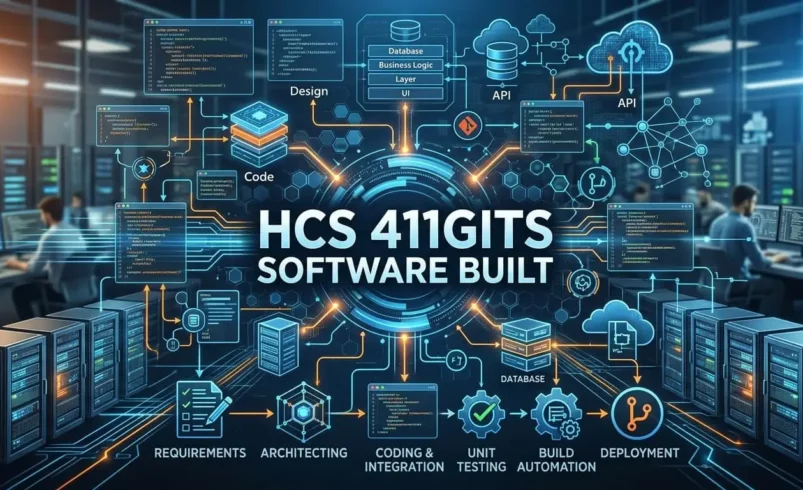
How HCS 411GITS Software Built: Understanding Its Development, Architecture, and Engineering Process
November 16, 2026
0
Building complex software involves considerably more than writing instructions that tell a computer what to do. A reliable application must translate user requirements into working features, organize information,
Building complex software involves considerably more than writing instructions that tell a computer what to do. A reliable application must translate user requirements into working features, organize information, communicate with other systems, protect sensitive data, and remain stable as its environment changes. These responsibilities are connected, and decisions made during the early stages of development can influence the software for years.
The search term How HCS 411GITS Software Built raises an interesting technical question. Readers want to understand the development process behind HCS 411GITS, including the programming technologies, architecture, testing methods, and engineering decisions that could be associated with software of this nature. However, there is an important limitation: the exact identity and internal implementation of HCS 411GITS are not established through reliable public technical documentation.
That means it would be misleading to assign it a particular developer, programming language, database, framework, release history, or proprietary architecture. A more useful explanation is to distinguish between what can be established about the search topic and the established engineering practices used to develop complex applications.
This article examines those practices in detail. It explains how a software concept becomes a technical blueprint, how application components are organized, how developers select programming languages, and why testing, security, deployment, and maintenance are essential parts of the development process.
HCS 411GITS at a Glance
The following table summarizes the subject of this article without presenting hypothetical engineering details as confirmed product specifications.
Fact
Details
Software Name
HCS 411GITS
Search Topic
Software Development and Engineering
Main Subject
Software Architecture and Development
Technical Focus
Programming, Testing and Deployment
Development Category
Software Engineering
Architecture Discussion
Modular and Layered Architecture
Programming Discussion
Common Software Development Languages
Testing Discussion
Unit, Integration and System Testing
Maintenance Focus
Updates, Security and Performance
Research Approach
Verified Information and General Engineering Principles
The architecture, programming, and testing subjects in this table describe the engineering areas explored in the article. They should not be interpreted as confirmation that HCS 411GITS uses a particular design or technology.
Understanding the HCS 411GITS Software Question
Before examining how HCS 411GITS might have been developed, it is necessary to understand why identifying a software product matters. A technical name or keyword does not automatically reveal the nature of the system behind it. Similar terms can refer to commercial applications, internal company projects, software modules, educational projects, or subjects discussed in online publications.
A documented commercial application normally has identifiable product information. Its developer may publish an official website, technical documentation, release notes, supported platforms, installation instructions, or customer support information. These materials help users understand what the software does and provide developers with evidence about its technical characteristics.
An internal software project can be different. An organization may develop a system for its employees, suppliers, or customers without publishing detailed information about its architecture. Its internal documentation may describe programming languages, databases, integrations, and security arrangements, but those details might not be publicly accessible.
A third possibility is that a technical term appears in online articles without representing a clearly documented standalone application. In that situation, readers may encounter explanations of the name without finding enough evidence to identify a specific software product.
These distinctions matter when researching HCS 411GITS. Without reliable documentation, it is not possible to establish who created it, when development began, which technologies were selected, or how its internal components operate. General engineering principles can still explain how applications of comparable complexity are designed, but those principles must remain separate from claims about this particular term.
This approach also helps readers evaluate technical information more carefully. A statement that an application could use a relational database is not proof that it does. Similarly, describing a modular architecture does not establish that the software was actually built using separate modules.
From an Initial Idea to a Software Development Blueprint
Every substantial software project begins with a problem that needs to be addressed. Before developers choose a programming language or create database tables, they need to understand the people who will use the application and the tasks it must support.
This early stage is often called requirements analysis. Its purpose is to convert broad expectations into specific, understandable requirements. A project might initially be described as a system for managing information, for example, but that description is not detailed enough to guide implementation. Developers need to know what information is stored, who can access it, what actions users can perform, and which results the application must produce.
Requirement Gathering and User Workflow Analysis
Requirement gathering involves discussions with stakeholders, examination of existing processes, and documentation of expected software behaviour. Stakeholders can include customers, employees, managers, administrators, and technical teams.
User workflow analysis examines how people complete tasks. Consider a hypothetical application used to manage customer requests. A user might sign in, create a request, attach supporting information, submit it, and later check its status. An administrator might review the submission, assign it to an employee, and update its progress.
Each action creates a requirement. The application must recognize different user roles, accept valid information, store records, and display appropriate status updates. Mapping these workflows before programming helps developers identify missing steps and unnecessary complexity.
Functional and Non-Functional Specifications
Functional requirements describe what the application must do. These might include creating accounts, searching records, generating reports, processing submissions, or sending notifications.
Non-functional requirements describe how well the system should operate. Performance, availability, security, accessibility, compatibility, and reliability are common examples. A system may technically provide every requested feature but still fail if it responds too slowly or exposes information to unauthorized users.
Technical Feasibility and Architecture Planning
Once requirements are understood, the technical team evaluates whether the proposed system can be built within the available budget, schedule, and infrastructure. Developers consider expected user numbers, data volume, integration requirements, technical skills, and long-term maintenance responsibilities.
The resulting blueprint defines the major components, their responsibilities, and how they will communicate. It may include diagrams, database models, API specifications, security requirements, and development milestones.
A useful plan also identifies dependencies. If a reporting feature depends on information collected by another module, both teams need a shared understanding of the data structure and expected behaviour. Resolving these details early can prevent expensive changes later.
Inside the Architecture of a Modern Software Application
Software architecture describes the organization of an application and the relationships between its components. It is not simply a diagram showing servers and databases. It establishes how responsibilities are divided, how information moves, and how the system can be changed without creating unnecessary problems elsewhere.
The following architecture concepts are common in complex applications. They are general engineering approaches, not verified components of HCS 411GITS.
Frontend Development and User Interfaces
The frontend is the part of an application with which users directly interact. It may include web pages, forms, navigation menus, dashboards, search functions, and mobile screens.
A well-designed interface makes the application understandable. It should present information clearly, respond appropriately to user actions, and provide useful feedback when something goes wrong.
For a web application, frontend development commonly involves HTML, CSS, and JavaScript. Developers may also use frameworks and libraries to organize larger interfaces. These tools can support reusable components, interactive screens, and consistent design patterns.
The frontend should not be responsible for every important business decision. For example, hiding an administrative button from an ordinary user is not enough to protect an administrative operation. The backend must also verify the user’s permissions before accepting the request.
Backend Processing
The backend handles operations that take place behind the user interface. It can process requests, apply business rules, communicate with databases, validate information, and coordinate integrations.
Suppose a user submits a form containing customer details. The backend can check whether required fields are present, determine whether the user has permission to create the record, and store the approved information.
Separating backend responsibilities from interface design allows developers to support multiple ways of accessing the same application. A website and a mobile application, for example, may use the same backend services while presenting different interfaces.
Database Architecture and Information Management
Databases store and organize the information used by an application. Their design affects performance, consistency, security, and the ability to retrieve records accurately.
Relational database systems organize information into tables with defined relationships. They are commonly used when data has structured connections, such as customers, orders, employees, and transactions. PostgreSQL and MySQL are examples of relational database technologies.
Other applications may use document-oriented or key-value databases when their information requirements differ. MongoDB is an example of a document database.
Choosing a database depends on the data model, transaction requirements, expected workload, reporting needs, and operational environment. There is no single database that is automatically suitable for every application.
APIs and System Integrations
An application programming interface, commonly called an API, defines how different software components exchange information. APIs allow a frontend to request information from a backend or enable one application to communicate with an external service.
For example, a business platform might connect to a payment provider through an API. The application sends a request, the provider processes it, and a response communicates whether the operation succeeded.
APIs require clear rules about data formats, authentication, permissions, error handling, and version compatibility. Poorly designed integrations can create security risks or make the application difficult to maintain.
Authentication, Authorization, and Modular Design
Authentication confirms a user’s identity, usually through a password, passkey, or another verification method. Authorization determines which actions that authenticated user is allowed to perform.
These functions are related but different. A person may successfully sign in while still lacking permission to view financial records or manage other accounts.
Modular software development helps organize complex applications into smaller components with defined responsibilities. One module might manage accounts, another handle reporting, and another process notifications. The modules can be developed and tested separately while following shared technical rules.
A modular approach can reduce the impact of changes. Updating a reporting component should not require rewriting unrelated account-management functionality, provided the boundaries between the modules are properly designed.
Programming Languages and Development Technologies
Programming languages provide the instructions developers use to create software behaviour. Different languages have different strengths, ecosystems, performance characteristics, and development requirements. The best choice depends on the intended application rather than popularity alone.
There is no verified public technical documentation establishing which programming languages, if any, were used to develop HCS 411GITS. The following examples explain technologies commonly used in software engineering.
Python
Python is widely used for backend development, automation, data processing, scripting, and artificial intelligence applications. Its readable syntax can make it accessible to developers learning programming, while its libraries support a broad range of technical tasks.
A Python backend might receive information from a web interface, validate a request, communicate with a database, and return a structured response. Frameworks such as Django and Flask can help developers organize web application functionality.
Python can be particularly useful when a project includes data analysis or automation alongside ordinary application features. However, technology selection still depends on performance, deployment, integration, and maintenance requirements.
Java
Java is used in enterprise software, backend services, business systems, and Android-related development environments. Its established ecosystem and object-oriented programming model make it suitable for applications that require structured code and long-term maintenance.
Large organizations may use Java to build services that process transactions, manage records, or communicate with other business systems. Frameworks such as Spring provide additional capabilities for developing backend applications.
JavaScript
JavaScript is central to interactive web development. It allows websites to respond to user actions without requiring a complete page reload for every interaction.
With server-side environments such as Node.js, JavaScript can also be used for backend services. This allows development teams to use the same language across parts of the frontend and backend, although the architecture and responsibilities of those components remain distinct.
C#
C# is commonly associated with the .NET ecosystem. It supports web applications, enterprise platforms, desktop software, and services that connect with organizational systems.
Developers may choose C# when they need structured application development, strong tooling, and integration with Microsoft technologies. The language can support both small applications and substantial business systems.
C++
C++ is frequently used where performance, memory control, and low-level system interaction are important. It appears in areas such as game engines, embedded software, operating system components, and performance-sensitive applications.
Its capabilities also introduce complexity. Developers need to manage certain aspects of memory and resource handling carefully to avoid defects that may affect stability or security.
A project may use more than one programming language. A browser interface might rely on JavaScript, while backend services use Java or Python. Such combinations are normal when each technology serves a clearly defined purpose.
How Different Software Components Communicate
A modern application is rarely a single block of code. Its interface, backend, database, authentication services, and integrations work together through defined communication methods.
Consider a hypothetical customer-management application. A user signs in and searches for a particular customer record. The process demonstrates how several components can cooperate.
First, the frontend displays a search field and collects the user’s input. When the user submits the search, the interface sends a request to the backend through an API. The request may include the search term and an authentication token that identifies the active session.
The backend receives the request and checks whether it is valid. It verifies the user’s identity and permissions, then determines which database operation is required. If the user is authorized, the backend sends a query to the database.
The database searches the relevant records and returns the matching information. The backend processes the result, applies any additional access restrictions, and prepares a response. The frontend then displays the permitted information in a readable format.
This process can involve several safeguards. The backend may limit the number of records returned, reject invalid search terms, and record important administrative actions. The database may also use indexes to make searches faster.
The same general process applies to many application functions. A report request, account update, or notification can involve multiple components exchanging information.
Understanding these relationships is important when evaluating software architecture. A failure in one component can affect the user experience even when the remaining parts are operating correctly. For example, a working interface cannot display updated records if the database connection is unavailable.
The Testing Process Behind Reliable Applications
Software testing is the process of checking whether an application behaves as expected. It helps identify defects before users depend on the system and provides evidence that changes have not damaged existing functionality.
Testing is not a single activity performed only at the end of development. It can take place throughout the software development lifecycle, beginning with individual components and continuing through deployment.
Unit Testing
Unit testing examines small sections of code independently. A developer might test a function that calculates a total, checks a date, or validates a particular input.
The purpose is to identify errors close to where they originate. When a small function fails a test, developers can usually investigate it without examining the entire application.
Integration Testing
Integration testing examines whether separate components work correctly together. A backend service might function independently, and a database might respond correctly, but problems can still occur when the two communicate.
These tests examine interfaces, data formats, authentication, and expected responses between components.
Functional and System Testing
Functional testing checks whether specific features meet their requirements. A login feature, for example, should accept valid credentials, reject invalid ones, and provide appropriate feedback.
System testing examines the application as a complete system. It considers how the different components operate together under realistic conditions.
Performance Testing
Performance testing examines how an application behaves under different workloads. Developers may evaluate response times, resource consumption, concurrent users, and the system’s ability to handle increasing demand.
Load testing checks performance under an expected workload, while stress testing examines what happens when the system is pushed beyond normal operating conditions.
Security Testing
Security testing looks for weaknesses that could expose information or allow unauthorized actions. It may involve reviewing code, checking access controls, examining dependencies, and conducting vulnerability assessments.
Testing should include both technical weaknesses and mistakes in application logic. A system can use secure connections but still expose private records if its permission checks are incorrectly implemented.
User Acceptance Testing
User acceptance testing involves checking whether the application supports the real tasks expected by its users. Technical teams may consider a feature complete, but actual users can identify confusing workflows or missing requirements.
Feedback from this stage can lead to interface improvements, clearer instructions, or changes to business rules before a wider release.
Security, Data Protection, and Software Reliability
Security is a fundamental engineering responsibility. It should influence requirements, architecture, programming, testing, deployment, and maintenance rather than being treated as a final feature added after development.
Authentication and authorization are two important controls. Authentication establishes who is using the application, while authorization restricts what that user can do. Applying permissions at the backend is particularly important because interface restrictions alone can often be bypassed.
Encryption protects information by making it unreadable to parties who do not possess the required keys. Applications commonly use encrypted connections to protect information moving between users and servers. Sensitive information stored in databases or backups may also require encryption, depending on the risk and system requirements.
Input validation is another essential practice. Applications should not assume that information received from a user or external service is safe. Developers need to check formats, lengths, permitted values, and other rules before processing data.
Secure coding practices also reduce common weaknesses. Developers should avoid exposing passwords or secret keys in source code, handle errors without revealing confidential information, and keep software dependencies updated.
Backups help organizations recover from accidental deletion, hardware failure, corruption, or certain security incidents. However, simply creating backups is not enough. Teams should periodically test whether the information can actually be restored.
Vulnerability management continues after release. New weaknesses may be discovered in software libraries, operating systems, or infrastructure. Organizations need a process for assessing these issues, prioritizing updates, and confirming that fixes have been applied correctly.
For a broader understanding of how technology companies approach these responsibilities, readers can explore WorldMagazine.blog’s article on Trango Tech employees and IT security leadership. It provides a related discussion of security responsibilities within a software services environment.
Deployment and the Journey Beyond Development
Writing and testing software does not automatically make it available to users. The application must be prepared for a production environment, configured correctly, and monitored after release.
Development environments are used to create and modify code. Testing environments allow teams to evaluate changes under controlled conditions. Production environments are where the application operates for its intended users.
Keeping these environments separate reduces the risk of unfinished features or experimental changes affecting live operations.
Version Control and Git Workflows
Version control systems record changes to source code over time. They allow developers to review earlier versions, collaborate on shared projects, and identify when a defect was introduced.
Git is one of the most widely used version control systems. Developers can create branches to work on separate features, commit changes, and merge approved work into a shared codebase.
A typical team workflow might involve a developer creating a branch for a new feature, making changes, and submitting those changes for review. Other team members can examine the code, request improvements, and run automated tests before the changes are merged.
This process makes development more organized. It also provides a history of code changes that can help teams investigate problems.
Continuous Integration and Continuous Delivery
Continuous integration, commonly abbreviated as CI, involves regularly combining code changes and checking them through automated processes. These checks may include compiling the application, running tests, and examining code quality.
Continuous delivery and continuous deployment extend this process toward releasing software. In a continuous delivery workflow, changes are prepared so they can be deployed when approved. Continuous deployment can automatically release qualifying changes after the required checks pass.
These practices reduce repetitive manual work, but they do not eliminate the need for review. Automated pipelines must be configured carefully, and important releases may still require approval.
Hosting, Release Management, and Monitoring
Applications can be hosted on physical servers, virtual machines, managed platforms, or cloud infrastructure. The appropriate environment depends on expected traffic, performance needs, security requirements, cost, and operational capacity.
Release management controls how updates reach users. Teams may release changes gradually, monitor their effect, and maintain a rollback plan in case a deployment causes serious problems.
Monitoring helps technical teams understand whether the application is operating normally. They may track response times, server resources, error rates, database performance, and service availability.
Logs provide records of important system events. When a problem occurs, developers and administrators can use logs and monitoring information to identify the affected component and investigate the cause.
Readers interested in the wider relationship between operating systems, infrastructure, and application delivery can also explore Linux and modern technology developments. Linux is one part of the broader infrastructure environment used across many development and hosting workflows.
What Keeps Software Improving After Its Initial Release?
An application is not necessarily finished when its first version becomes available. Users discover new requirements, operating systems change, external services introduce updates, and security weaknesses may emerge. Maintenance keeps software useful and dependable as these conditions evolve.
Bug Fixes and Compatibility Updates
A bug is an error or unexpected behaviour in software. Some defects affect only unusual situations, while others can prevent users from completing important tasks.
Developers investigate reported problems, reproduce them, identify their cause, and prepare fixes. The corrected code then goes through suitable testing before release.
Compatibility updates address changes in browsers, operating systems, devices, databases, and external services. Without ongoing compatibility work, an application may gradually become less reliable even if its original code has not changed.
Performance Improvements
As usage increases, a system may develop performance problems. Database queries might become slower, pages may take longer to load, or background tasks may consume excessive resources.
Developers use monitoring information and performance tests to identify bottlenecks. Improvements might involve database indexing, caching, more efficient algorithms, or changes to infrastructure.
Performance work should be based on evidence. Rewriting a component without understanding the actual bottleneck can add complexity without solving the problem.
Documentation and Technical Knowledge
Technical documentation explains how an application is structured, configured, deployed, and maintained. It can include API descriptions, database diagrams, setup instructions, troubleshooting procedures, and development guidelines.
Good documentation is valuable when team members change or when a project becomes large enough that no individual understands every component. It also helps developers make changes without relying entirely on informal knowledge.
Architecture and Long-Term Development
Well-organized architecture makes it easier to introduce new functionality. If components have clear responsibilities and communicate through stable interfaces, developers can often update one area without changing the entire application.
Poorly structured software can become difficult to maintain. Small changes may create unexpected problems in unrelated features, and developers may spend more time understanding existing code than implementing improvements.
This is why architecture decisions matter beyond the initial release. The cost of software development includes not only the work required to create an application but also the effort needed to keep it secure, compatible, and useful.
The wider technology environment continues to evolve, as discussed in WorldMagazine.blog’s coverage of cloud technologies and modern digital systems. Cloud infrastructure, DevOps, and data management all influence how applications are operated and improved over time.
FAQs About How Hcs 411gits Software Built
1. How was HCS 411GITS software built?
The exact development process behind HCS 411GITS is not established through reliable public technical documentation. Therefore, its original developers, programming languages, architecture, and development history cannot be confirmed. In general, complex applications are built through requirements analysis, architecture planning, frontend and backend programming, database design, testing, deployment, and ongoing maintenance.
2. What programming language does HCS 411GITS use?
There is no verified public technical specification identifying the programming language used by HCS 411GITS. Modern applications can be developed with Python, Java, JavaScript, C#, C++, and other languages. The selection depends on the application’s purpose, performance requirements, infrastructure, development team, and integration needs.
3. What is the architecture behind HCS 411GITS?
A confirmed architecture diagram or technical specification for HCS 411GITS is not publicly established here. Modern software commonly uses layered or modular architecture, separating user interfaces, backend processing, databases, APIs, and security controls. These designs help developers organize responsibilities, test components, and maintain complex applications, but they should not be presented as confirmed HCS 411GITS features.
4. Does HCS 411GITS use modular software development?
It cannot currently be confirmed whether HCS 411GITS uses modular software development. Modularity is a common engineering approach in which an application is divided into components with clearly defined responsibilities. This can make large projects easier to develop, test, update, and maintain because changes can often be limited to the relevant component.
5. How are complex software applications tested?
Complex applications are tested through several methods. Unit tests examine individual functions, integration tests check communication between components, and system tests evaluate the complete application. Performance and security testing examine reliability under different conditions, while user acceptance testing checks whether the software supports real user requirements. Testing throughout development helps identify defects before they affect users.
6. What role does Git play in software development?
Git is a version control system that records changes to source code. It helps developers work on separate features, review modifications, collaborate with other programmers, and restore earlier versions when necessary. Teams often use branches and code reviews to manage changes before merging them into a shared project. Git supports development organization but does not replace software testing.
7. How does software deployment work?
Deployment is the process of making an application available in its intended production environment. Developers prepare the application, configure its services, verify dependencies, and release the approved version. Modern teams may use automated pipelines to run tests and manage releases. Monitoring then helps identify errors, performance issues, and service interruptions after the application becomes available.
8. Why is software maintenance important?
Software maintenance keeps an application secure, compatible, and functional after its initial release. It includes correcting defects, applying security patches, improving performance, updating dependencies, and responding to changing user requirements. Without maintenance, an application may become unreliable as its operating environment changes or new vulnerabilities are discovered.
9. Is the exact HCS 411GITS development process publicly documented?
The exact development process, technical team, programming languages, architecture, and release history of HCS 411GITS are not established through reliable public technical documentation available for this discussion. Readers should look for official product documentation, identifiable developer information, release notes, or technical specifications before accepting product-specific claims.
10. What technologies are commonly used to build modern software?
Modern software development can involve programming languages such as Python, Java, JavaScript, C#, and C++. Developers may also use frameworks, relational or document databases, APIs, Git, automated testing tools, cloud infrastructure, and monitoring platforms. The combination varies according to the project’s purpose, expected workload, security requirements, and long-term support needs.
Conclusion: The Process That Turns Code Into Reliable Software
Understanding how complex software is built requires looking beyond programming languages and individual features. Planning determines what the application must accomplish. Architecture organizes its responsibilities. Programming turns the design into working functionality, while databases and APIs allow components to exchange information. Testing identifies defects, security controls protect information, and deployment makes the finished application available to users.
The question How HCS 411GITS Software Built deserves the same careful distinction between documented facts and general engineering knowledge. Its exact developers, internal architecture, programming technologies, and development history cannot be confirmed through reliable public technical documentation. Assigning specific tools or design decisions to it without evidence would create an inaccurate technical account.
Nevertheless, the engineering principles discussed here explain the processes involved in creating and operating sophisticated applications. Whether a project uses Python, Java, modular services, relational databases, or another combination of technologies, its long-term reliability depends on thoughtful requirements, sound design, careful implementation, effective testing, and continuous maintenance.
Ultimately, dependable software is not defined by a programming language alone. It is the result of many connected engineering decisions, made carefully and improved throughout the application’s life.