Graphic design has become an important part of modern communication. Businesses use visual content to introduce their products, creators use graphics to build online audiences, and organizations rely on professional designs to communicate information clearly. From social media posts and website layouts to advertisements, logos, illustrations, and digital artwork, visual design influences how people understand and interact with information.
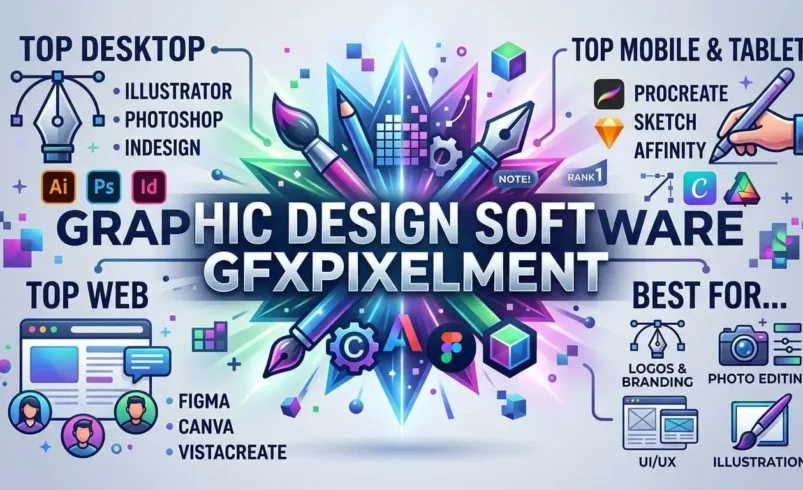
As interest in digital creativity grows, people increasingly search for tools that can help them create professional-looking graphics. One search phrase that raises questions is what are graphic design software GFXPixelment. The wording combines a familiar topic, graphic design software, with the name GFXPixelment. Understanding what the phrase means requires looking at both its parts and the wider collection of tools used for digital design.
Graphic design software refers to applications that allow users to create, edit, arrange, and improve visual content. These applications can support different activities, including photo editing, vector illustration, page layout, typography, interface design, and digital drawing. GFXPixelment, meanwhile, is associated with online content about technology and design. It should not automatically be treated as the name of a confirmed standalone graphic design application.
This distinction matters because a website discussing design software and an actual software product are two different things. Someone researching GFXPixelment may be looking for information about graphic design tools, an explanation of the term, or guidance on choosing an application. This article explores the meaning of the search phrase, explains the main categories of graphic design software, and examines the tools that beginners and experienced designers commonly consider.
What Does What Are Graphic Design Software GFXPixelment Mean?
The phrase what are graphic design software GFXPixelment can be understood as a search for information about graphic design applications connected with the GFXPixelment name or content. It is not a conventional product category like vector illustration software, photo editing software, or desktop publishing applications.
The first part of the phrase refers to graphic design software in general. These are digital tools that provide features for producing visual material. A designer might use one application to adjust photographs, another to create a logo, and a third to arrange text and images into a magazine page.
The GFXPixelment part introduces a separate question. People encountering the name may want to know whether it represents a design platform, a software package, a website, or a resource that discusses creative technology. It is important not to confuse an online information resource with a downloadable application. Without clear product documentation, a verified download, or an official description identifying a standalone application, GFXPixelment should not be presented as an established graphic design program.
For readers, the practical value of the search is understanding the software landscape. Instead of assuming that every name associated with design content represents an application, it is more useful to identify the actual tools available, understand their purposes, and choose one based on the work being planned.
What Is Graphic Design Software?
Graphic design software is a category of digital applications used to create and modify visual communication. These tools provide a working environment where users can combine shapes, colours, photographs, illustrations, text, and other visual elements.
A simple social media graphic may require only a background, a headline, and a photograph. A professional branding project can involve much more, including logo variations, typography systems, colour palettes, business stationery, and advertising materials. Software makes it possible to organize these elements and adjust them without repeatedly creating everything from the beginning.
Most design applications provide a combination of tools such as:
- Drawing and shape creation tools.
- Text and typography controls.
- Colour selection and adjustment options.
- Image cropping and editing features.
- Layers and object organization.
- Templates and reusable design elements.
- Export options for digital and print formats.
Not every application includes all these features. Some focus on photographs, while others are designed for illustrations, layouts, or user interfaces. Selecting the right software depends on the type of visual work rather than simply choosing the application with the largest number of features.
Main Types of Graphic Design Software
Understanding different software categories makes it easier to identify which tools are suitable for a particular project. Although some applications offer features across multiple categories, most have a primary purpose.
1. Raster Graphics and Photo Editing Software
Raster graphics are made from individual pixels. Photographs and many digital paintings use this format. When a raster image is enlarged significantly beyond its original dimensions, its pixels may become visible, making the image appear blurry or blocky.
Photo editing applications allow designers to improve photographs, remove unwanted objects, adjust brightness, change colours, combine images, and create visual compositions. They are particularly useful for advertising graphics, website banners, social media images, and promotional artwork.
<PRIVATE_PERSON> Photoshop is a well-known example of raster graphics and photo editing software. Its tools support detailed image manipulation, layers, masks, selections, colour correction, and compositing. It can be useful for photographers, advertising designers, digital artists, and professionals working with complex image compositions.
Other raster-focused options include GIMP, which provides image editing capabilities without requiring a paid subscription, and Affinity Photo, which offers professional photo editing and image manipulation features.
2. Vector Graphics Software
Vector graphics are created using mathematical paths, curves, points, and shapes rather than a fixed arrangement of pixels. This makes vector artwork especially useful when designs need to appear at different sizes.
A company logo, for example, may be displayed on a small business card and a large outdoor sign. A vector design can be resized for both purposes while maintaining clean edges, provided it is exported appropriately.
Vector software is commonly used for:
- Logo design.
- Icons and symbols.
- Illustrations.
- Infographics.
- Packaging graphics.
- Typography-based artwork.
Adobe Illustrator is one of the best-known applications in this category. It provides tools for drawing paths, editing shapes, creating gradients, and arranging complex vector compositions.
CorelDRAW is another established vector design application, often used for illustration, signage, promotional graphics, and print-related work. Affinity Designer is also an option for users who want vector and raster design capabilities within a creative application.
3. Layout and Desktop Publishing Software
Some design projects involve more than one image or illustration. Magazines, brochures, books, catalogues, reports, and newsletters require carefully arranged pages containing headings, paragraphs, photographs, captions, and other elements.
Layout software helps designers manage these components across individual pages or longer documents. It provides tools for columns, margins, grids, page numbering, typography, and consistent formatting.
Adobe InDesign is widely used for professional publishing projects. It is suitable for documents with multiple pages, complex layouts, and detailed typographic requirements.
Affinity Publisher is another desktop publishing option. It can be used for brochures, books, magazines, and other documents where page structure and visual consistency are important.
4. UI and UX Design Software
User interface design focuses on the visual parts of digital products, including websites, mobile applications, dashboards, and software interfaces. User experience design considers how people interact with those products and whether the experience is understandable and convenient.
UI and UX designers often need to create screen layouts, navigation structures, buttons, forms, icons, and interactive prototypes. Their work requires tools that support reusable components, collaboration, and organized design systems.
Figma is a popular interface design and prototyping platform. It allows designers to create screens, build reusable components, share projects, and collaborate with other team members.
Other tools and platforms may support wireframing, prototyping, product planning, and interface development. The best option depends on the team’s workflow, project requirements, and preferred collaboration environment.
5. Digital Drawing and Illustration Software
Digital illustration applications are designed for artists who want to create artwork using a mouse, drawing tablet, or touchscreen. They commonly provide brushes, pencils, texture effects, layers, blending modes, and pressure-sensitive drawing controls.
These tools are used for character illustrations, concept art, comics, digital paintings, educational drawings, and creative projects.
Some applications focus on traditional drawing experiences, while others provide advanced features for professional illustration. The choice often depends on the artist’s preferred drawing style and the type of artwork being produced.
Popular Graphic Design Software to Know
People searching for GFXPixelment-related design information may also want to understand which actual applications are available. The following tools represent different areas of the graphic design industry.
Adobe Photoshop
<PRIVATE_PERSON> Photoshop is widely recognized for photo editing and raster-based creative work. It allows users to work with layers, masks, selections, filters, brushes, and image adjustments.
A designer can use it to prepare product photographs, create advertising graphics, remove backgrounds, combine several images, or produce digital artwork. Its extensive feature set makes it suitable for detailed projects, although beginners may need time to understand its interface.
Photoshop is not necessarily the best choice for every design task. For example, someone creating a simple multi-page publication may find dedicated layout software more convenient. A designer producing scalable logos may prefer a vector application.
Adobe Illustrator
Adobe Illustrator is designed primarily for vector graphics. Its tools help users create logos, icons, illustrations, patterns, and other artwork that needs to remain sharp at different sizes.
The software provides detailed control over paths, anchor points, shapes, strokes, and typography. This makes it useful for branding projects and professional illustration.
However, Illustrator has a learning curve. Beginners should start with basic shapes, the pen tool, alignment, and colour controls before moving into more complicated illustrations.
Canva
Canva is a design platform focused on accessible visual creation. It provides templates and editing tools for social media graphics, presentations, posters, invitations, marketing materials, and other everyday design tasks.
Its template-based workflow can help beginners create designs without learning every technical aspect of professional graphic design software. Users can select a layout, replace text, adjust colours, upload images, and export the finished design.
Canva is particularly useful for individuals and small businesses that regularly need visual content. However, complex illustration and advanced image manipulation may require more specialized applications.
CorelDRAW
CorelDRAW is a vector graphics application used for illustration, branding, signage, print design, and promotional artwork. It offers tools for creating and editing shapes, curves, text, and graphic elements.
It is often considered by designers working with print production and visual communication. Its suitability depends on the type of projects being handled and the formats required by clients or printing providers.
Figma
Figma is widely used for interface design and collaborative product development. It allows teams to create website layouts, mobile application screens, interactive prototypes, and reusable design components.
One of its strengths is collaboration. Multiple team members can review designs, share feedback, and work within the same project environment.
It is not intended to replace every traditional graphic design application. Instead, it is particularly useful when the goal is designing and testing digital product interfaces.
Affinity Designer
Affinity Designer supports vector illustration and raster-based design workflows. It can be used for logos, icons, illustrations, branding materials, and other creative projects.
Designers may consider it when they want a dedicated creative application with professional drawing and editing tools. Its workflow and available features should be compared with other applications before making a purchase decision.
GIMP
GIMP is a free and open-source image editing application. It offers tools for image adjustments, selections, layers, retouching, and digital artwork.
It can be a useful starting point for learners who want to explore image editing without immediately paying for a commercial subscription. However, its interface and workflow may feel different from other applications, so beginners should allow time to become familiar with its tools.
How to Choose the Right Graphic Design Software
Choosing design software should begin with the intended project. A tool that works well for editing photographs may not be suitable for creating a professional logo or designing a magazine.
Before selecting an application, consider the following factors.
Identify Your Design Requirements
Start by writing down the type of work you expect to create. Are you interested in social media graphics, logos, illustrations, product images, website layouts, or printed publications?
A person who wants to create simple promotional graphics may be comfortable with a template-based platform. Someone planning to build a career in branding may benefit from learning vector illustration software. A photographer may need advanced image editing features.
Identifying the purpose first prevents unnecessary spending and makes the learning process more focused.
Consider Your Experience Level
Beginners often benefit from applications with clear interfaces, helpful tutorials, and straightforward workflows. Starting with complicated professional software can sometimes make simple tasks feel unnecessarily difficult.
This does not mean beginners should avoid professional tools. It means they should choose an application that matches their current needs and gradually explore more advanced features.
A new designer might begin with Canva for basic layouts and then learn Photoshop or Illustrator when their projects require greater control.
Check Your Budget
Graphic design applications have different pricing models. Some are free, some offer paid subscriptions, and others use one-time purchase arrangements.
The cost should be compared with the features required for the project. Paying for a professional application may be worthwhile when it supports regular commercial work, but a beginner creating occasional graphics may not need an expensive plan.
It is also important to consider whether a subscription includes the tools and services that are actually needed.
Review System Requirements
Design software can place different demands on a computer. Applications used for large images, detailed illustrations, and complex compositions may require more memory and processing power.
Before installing a program, check its supported operating system, hardware requirements, available storage, and compatibility with existing devices.
A tool that works smoothly on one computer may perform poorly on another. Testing performance before committing to a long-term workflow can save time and frustration.
Consider File Formats and Compatibility
Design projects are often shared with clients, printers, developers, or other creative professionals. This makes file compatibility an important consideration.
Some projects need editable source files, while others require formats such as PNG, JPEG, SVG, PDF, or TIFF. A logo may need a vector file, whereas a website photograph may be delivered as a compressed image.
Choose software that supports the formats required by the people who will use the finished work.
Why Graphic Design Software Matters in Modern Work
Visual communication has become essential across many industries. Businesses need promotional graphics, educational organizations use diagrams and presentations, and digital publishers rely on attractive layouts to organize information.
Graphic design software makes these activities more manageable by providing tools for creating consistent and reusable visual content.
Business Branding
A recognizable visual identity helps a business present itself consistently. Logos, colours, typography, packaging, and promotional graphics contribute to the overall appearance of a brand.
Design applications allow businesses and designers to create these elements and adapt them for different platforms. The same visual identity may need to appear on a website, social media account, brochure, product label, and printed advertisement.
Social Media Marketing
Social media platforms depend heavily on visual communication. Businesses publish promotional images, product announcements, event graphics, and educational posts to attract attention and communicate messages.
Graphic design tools make it easier to prepare content in different dimensions and maintain a consistent visual style. Templates can help users produce regular posts, while advanced editing tools provide greater control over the final appearance.
Website and Application Design
Websites and mobile applications require organized layouts, readable typography, clear navigation, and recognizable interface elements.
UI design applications help teams plan and test these visual components before development. Designers can create screen mockups and interactive prototypes, making it easier to identify problems before a product is released.
Education and Learning
Teachers, students, and educational content creators use graphics to explain complicated ideas. Diagrams, charts, posters, presentations, and illustrated instructions can make information easier to understand.
Even basic design skills can help students prepare more organized assignments and presentations. More advanced applications provide opportunities to explore illustration, visual storytelling, and professional publishing.
Digital Publishing
Online magazines, blogs, and publishing platforms need visual elements that support written content. Featured graphics, infographics, article illustrations, and page layouts can improve the presentation of information.
Design software allows publishers to prepare these elements while maintaining a consistent visual identity across different articles and sections.
Can Beginners Learn Graphic Design Software?
Yes. Beginners can learn graphic design software through consistent practice and a structured approach. They do not need to master every application before producing useful work.
The most effective starting point is learning basic design principles. These include colour, contrast, alignment, spacing, hierarchy, balance, and typography. Understanding these concepts helps people create better visuals regardless of the software they use.
A beginner can follow a simple learning process.
Step 1: Learn Basic Design Principles
Before focusing on advanced software features, understand how visual elements work together. Learn why some colours complement each other, how spacing affects readability, and how typography influences the appearance of a design.
These principles are useful across nearly every type of graphic design project.
Step 2: Choose One Application
Avoid installing several applications and trying to learn all of them at once. Choose one tool that matches your immediate goal.
For simple social media graphics, a beginner-friendly platform may be enough. For photo editing, consider a raster graphics application. For logos and scalable illustrations, explore vector software.
Step 3: Follow Practical Tutorials
Tutorials can explain how to use tools, organize layers, adjust images, and export designs. However, simply watching videos is not enough.
After following a tutorial, repeat the task without copying every step. Experiment with different colours, layouts, and visual elements to understand how each feature works.
Step 4: Create Small Projects
Practice becomes more useful when it produces a finished result. Start with simple projects such as a promotional poster, a social media post, a basic logo concept, or a presentation cover.
These exercises help beginners develop confidence while building a collection of work that demonstrates their progress.
Step 5: Review and Improve Your Designs
After completing a design, examine it carefully. Check whether the main message is easy to understand, whether the text is readable, and whether the spacing feels balanced.
Ask for feedback from other people when possible. Constructive criticism can reveal problems that may not be obvious to the person who created the design.
Common Mistakes to Avoid When Using Design Software
Learning an application is only one part of becoming a capable designer. Users should also develop habits that help them produce clear, practical, and professional work.
Using Too Many Fonts
Combining too many typefaces can make a design look inconsistent. Most simple projects work well with a limited number of complementary fonts.
The important goal is to create a clear hierarchy between headings, supporting text, and smaller details.
Choosing Colours Without a Plan
A design can become visually confusing when too many unrelated colours are used. A small, consistent palette usually creates a more organized appearance.
Designers should also consider contrast. Text needs to remain readable against its background, particularly when graphics are viewed on smaller screens.
Ignoring Alignment and Spacing
Poor alignment can make a design feel unfinished. Elements should have a clear relationship with one another, and spacing should be consistent.
Using guides, grids, and alignment tools can help maintain structure.
Exporting in the Wrong Format
A file that looks correct inside a design application may not be suitable for every final use. Images for websites, vector logos, and print documents often require different formats and export settings.
Understanding the purpose of the finished file helps users select the correct format, resolution, and dimensions.
Relying Entirely on Templates
Templates can save time, but using them without meaningful customization may result in generic designs. Users should adjust colours, typography, layouts, and visual elements to match the purpose and identity of the project.
Templates are useful starting points, not substitutes for design judgment.
The Role of Artificial Intelligence in Graphic Design Software
Artificial intelligence is changing how people approach digital design. Many modern creative tools include features that can assist with background removal, image enhancement, content generation, layout suggestions, and repetitive editing tasks.
These features can reduce the time required for certain activities. For example, an automated background removal tool may help separate a product from its original photograph. Other features can suggest visual variations or assist with adjusting an image.
However, AI does not remove the need for human judgment. Designers still need to decide whether an image communicates the right message, whether a layout is readable, and whether a visual concept matches the client’s requirements.
AI-generated results may also need editing. They can contain visual inconsistencies, incorrect details, or elements that do not fit the intended design. Reviewing and improving the output remains important.
For beginners, AI features can make some tasks easier, but learning basic design principles is still valuable. Understanding composition, typography, contrast, and colour helps users evaluate automated suggestions rather than accepting every result without consideration.
Is GFXPixelment a Graphic Design Software Application?
This is one of the most important questions behind the keyword. GFXPixelment is associated with online technology and design-related content, but it should not be described as a verified standalone graphic design application without clear evidence of an actual software product.
A software application normally has identifiable product information. This may include an official product description, supported operating systems, feature documentation, installation instructions, pricing details, or a working application interface.
A website that publishes articles about graphic design software does not automatically provide its own design program. It may explain creative tools, discuss digital trends, or publish educational content without being an application itself.
For that reason, readers should distinguish between information about graphic design software and the software products themselves. If someone is looking for an application to edit photographs, create logos, or design website layouts, they should evaluate established tools according to their actual requirements.
The GFXPixelment name may help users locate design-related information, but it should not be treated as proof that a dedicated application exists. Checking the identity and functionality of a product before downloading or purchasing it is always a sensible step.
What Should You Look for Before Downloading Graphic Design Software?
Downloading creative software requires a little research. Not every program advertised online is suitable for professional work, and users should understand what they are installing.
First, look for the application’s official website or a trusted distribution platform. Avoid unfamiliar download pages that provide limited information about the developer or product.
Next, review the software’s features and system requirements. Confirm that it supports your operating system and includes the tools needed for your projects.
Users should also examine the licensing model. Some applications are free for personal use but require payment for commercial projects. Others provide limited free versions with paid upgrades.
Finally, check whether the application supports the file formats required by your workflow. This is especially important when designs will be delivered to clients, shared with colleagues, or sent to professional printing services.
A careful selection process can prevent compatibility problems and unnecessary expenses.
The Future of Graphic Design Software
Graphic design software will continue to develop as creative technology changes. Cloud-based workflows, collaborative editing, artificial intelligence, and improved interface tools are already influencing how designers work.
Cloud platforms make it easier for teams to access projects and share feedback. Collaboration features can reduce the need to exchange multiple versions of the same file, while reusable components help maintain consistency across large projects.
AI-assisted editing may also become more integrated into creative workflows. Tasks that once required several manual steps can increasingly be completed with automated tools. However, the quality of the final design will still depend on creative decisions, clear communication, and careful review.
Another important development is accessibility. Beginner-friendly platforms allow more people to create visual content without extensive technical experience. At the same time, professional applications continue to provide advanced control for complex projects.
The future is unlikely to depend on one application replacing every other tool. Different software products serve different purposes, and designers may continue using several applications within the same project.
Frequently Asked Questions
1. What are graphic design software GFXPixelment?
The phrase refers to a search for information about graphic design software associated with the GFXPixelment name. Graphic design software includes applications used to create and edit images, illustrations, logos, layouts, and digital content. GFXPixelment should not automatically be considered a confirmed standalone design application.
2. Is GFXPixelment an actual graphic design software?
GFXPixelment is associated with online technology and design content, but it should not be presented as a verified standalone graphic design application without reliable product documentation or evidence of an actual program.
3. Which graphic design software is best for beginners?
Canva is a beginner-friendly option for creating social media graphics, presentations, posters, and promotional materials. Beginners interested in more advanced editing can also explore GIMP or gradually learn professional applications such as Photoshop and Illustrator.
4. What software do professional graphic designers use?
Professional designers use different applications depending on their work. Photoshop is commonly used for image editing, Illustrator for vector graphics, InDesign for page layouts, and Figma for interface design and prototyping. The right choice depends on the project.
5. Is free graphic design software useful?
Yes. Free applications can provide useful tools for image editing, illustration, and basic design projects. GIMP is one example of free image editing software. Whether a free tool is sufficient depends on the features, file formats, and workflow required.
6. What is the difference between Photoshop and Illustrator?
Photoshop primarily works with raster images made from pixels, making it suitable for photo editing and digital image manipulation. Illustrator focuses on vector graphics, making it useful for logos, icons, and scalable illustrations.
7. Can I create a logo using graphic design software?
Yes. Vector applications such as Adobe Illustrator, CorelDRAW, and Affinity Designer are suitable for logo creation. They allow designers to build shapes, adjust paths, work with typography, and prepare artwork for different sizes.
8. Do I need an expensive computer for graphic design?
Not always. Basic design work can be completed on many ordinary computers, particularly when using lightweight applications or browser-based platforms. More demanding projects involving large files and complex editing may require stronger hardware.
9. Is graphic design difficult to learn?
Graphic design requires practice, but beginners can start with simple projects and gradually develop their skills. Learning basic principles such as colour, alignment, contrast, typography, and spacing makes it easier to improve.
10. Can AI replace graphic designers?
AI can assist with repetitive tasks and generate creative suggestions, but it does not fully replace human judgment. Designers remain responsible for understanding project requirements, developing concepts, reviewing results, and ensuring that the final work communicates effectively.
Conclusion
Understanding what are graphic design software GFXPixelment requires separating the general concept of graphic design applications from the GFXPixelment name. Graphic design software includes a wide range of tools for photo editing, vector illustration, page layout, digital drawing, and interface design. Each category serves a different purpose, and the best application depends on the work a person wants to create.
Photoshop, Illustrator, Canva, CorelDRAW, Figma, Affinity Designer, and GIMP are examples of actual creative tools that users can explore. Beginners can start with accessible applications and gradually develop more advanced skills as their projects become more demanding.
GFXPixelment is associated with online technology and design-related content, but it should not be confused with a confirmed standalone graphic design application. Readers should evaluate real software products through their features, compatibility, pricing, and official product information before downloading or purchasing them.
Ultimately, successful graphic design depends on more than the application being used. Creative thinking, visual communication, consistent practice, and an understanding of design principles are what help turn digital tools into meaningful results.
For More Visits: Worldmagazine