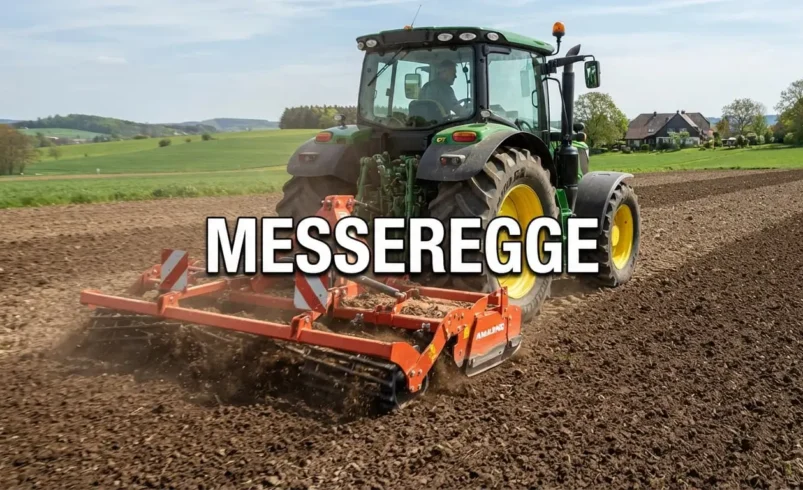
Messeregge: Meaning, Origins, Agricultural Identity, and Its Place in Modern Farming
November 23, 2026
0
Messeregge is an unusual term that can leave readers wondering what it actually represents. At first glance, it may look like a surname, a company name, or an
Messeregge is an unusual term that can leave readers wondering what it actually represents. At first glance, it may look like a surname, a company name, or an unfamiliar expression taken from another language. However, its established meaning is connected with German agricultural terminology and a specialized category of farming equipment.
The interesting part of Messeregge is that its meaning becomes considerably clearer when examined through its linguistic background. Rather than representing an individual or a widely recognized commercial organization, the word belongs to a technical vocabulary associated with agricultural machinery and soil preparation.
For readers unfamiliar with German farming terminology, this distinction is important. Specialized agricultural expressions are not always easy to translate directly into English, and a single unfamiliar word can create confusion when removed from its original context.
Messeregge offers an opportunity to explore more than a translation. Its linguistic construction, relationship with traditional farming vocabulary, and place within agricultural engineering help explain why such specialized terminology exists. It also illustrates how technical words can remain relevant within particular industries without becoming familiar to the general public.
Understanding the subject requires looking beyond the spelling and examining the agricultural identity behind the term.
Quick Profile: Messeregge at a Glance
Fact
Details
Full Name
Messeregge
Alternative Name
Knife harrow or blade harrow
Date of Birth
Not Applicable
Birthplace
Not Applicable
Nationality
German terminology
Profession
Not Applicable
Known For
Agricultural machinery terminology
Background
German agricultural vocabulary
Career
Not Applicable
Years Active
No specific historical period established
Net Worth
Not Applicable
Marital Status
Not Applicable
Spouse
Not Applicable
Children
Not Applicable
Notable Achievements
Recognition as a specialized agricultural equipment term
What Exactly Does Messeregge Mean?
The most established meaning of Messeregge belongs to agriculture. It is a German term associated with a knife harrow or scarifier, placing it within the wider category of equipment used in agricultural soil management.
The word is particularly interesting because its construction provides an indication of its meaning.
German frequently combines two or more words to create a new expression describing an object, activity, or technical category. This approach is common in everyday German as well as specialized professional vocabulary.
Messeregge follows this linguistic pattern.
Its components are associated with the German words Messer and Egge. The first means knife, while the second refers to a harrow, an agricultural implement.
Together, they help explain the agricultural identity of the expression.
However, understanding the translation does not automatically establish every historical detail about the term. Its exact first appearance, original inventor, and complete development cannot be confidently assigned without historical documentation.
This distinction separates an established meaning from assumptions that might otherwise become part of an inaccurate explanation.
Why Its Meaning Matters
Technical vocabulary allows professionals to communicate about equipment without describing every physical characteristic in lengthy sentences.
Farmers, engineers, manufacturers, and agricultural researchers regularly use specialized terminology to distinguish between machinery categories.
Messeregge belongs to this environment.
Its importance is not necessarily connected with worldwide popularity. Instead, it represents a particular expression within the broader language of agricultural engineering.
For someone researching the word, understanding this original context is more useful than treating it as an unexplained internet keyword.
The German Linguistic Background Behind Messeregge
German is well known for compound words. These expressions combine smaller linguistic elements to communicate more specific meanings.
This characteristic makes German technical vocabulary particularly interesting.
In some cases, a compound word can describe a physical object, its construction, or its intended function. Agricultural terminology contains numerous examples of this approach.
Messeregge is one such expression.
Understanding the Word Messer
Messer is the German word for knife.
It appears in numerous everyday expressions and technical descriptions. Depending on the surrounding terminology, it can refer to a cutting instrument or a blade-related component.
Within Messeregge, this component contributes to the general understanding of the equipment’s construction.
Understanding the Word Egge
Egge is a German agricultural word referring to a harrow.
A harrow belongs to the wider family of farming equipment associated with soil preparation.
The word is not limited to one particular machinery design. Agricultural implements have developed into different forms according to changing farming requirements.
This explains why the term is useful in agricultural discussions.
Why Compound Words Can Create Confusion
People who do not speak German may find compound expressions difficult to interpret.
A word can appear unfamiliar even when its individual components are relatively simple.
Another source of confusion is the difference between Messer and Messe.
These are separate German words. Messe can refer to a fair or exhibition, while Messer means knife.
Their similar spelling does not make them interchangeable.
Understanding this difference helps prevent incorrect explanations that connect Messeregge with unrelated subjects.
How Messeregge Became an Agricultural Search Topic
Not every specialized word becomes a widely recognized search term.
Some expressions remain largely within professional communities because the people who use them regularly already understand their meaning.
Messeregge is an example of terminology that can attract attention outside its original agricultural environment.
A person might encounter it while reading about German farming equipment, translating a technical document, or researching unfamiliar agricultural vocabulary.
Others may discover it through general internet searches.
The unusual spelling naturally encourages questions.
Is it a person? Is it a company? Does it describe a product? Is it a word from another language?
These questions are understandable, particularly when a term appears without an explanation.
The Influence of Specialized Vocabulary
Agricultural terminology contains many words that are unfamiliar outside farming communities.
Some describe machinery categories, while others refer to components, materials, or particular agricultural processes.
Such expressions can become searchable when people encounter them in technical material.
Messeregge illustrates this relationship between professional vocabulary and general curiosity.
Its search interest does not necessarily indicate that it has become a mainstream commercial product or cultural phenomenon.
Sometimes the explanation is much simpler: readers have discovered a technical expression and want to understand it.
Why Unfamiliar Terms Attract Attention
Words with unusual spelling often encourage investigation.
Readers may wonder whether they have discovered a new brand, an emerging technology, or a subject that has received little attention.
This curiosity can increase when a term is presented without surrounding information.
However, the number of online discussions surrounding a word should not be confused with its historical or commercial importance.
For Messeregge, the agricultural interpretation offers the most useful starting point.
Messeregge Within the Wider World of Agricultural Machinery
Agriculture depends on different types of machinery designed for specific purposes.
Preparing agricultural land involves more than one activity. Farmers must consider the condition of the soil, the intended crop, the existing field environment, and the wider production system.
This creates a need for specialized equipment.
Harrow-related machinery belongs to an important category within agricultural engineering.
Messeregge is associated with this broader equipment vocabulary.
The Importance of Soil Preparation
Soil preparation has an important relationship with crop production.
The physical condition of agricultural land influences several aspects of cultivation, including seed placement, moisture management, and the establishment of crops.
Different soils also behave differently.
Clay-rich ground, sandy soil, and mixed agricultural land can require different management approaches.
This is one reason agricultural machinery has developed into numerous specialized categories.
A particular implement may be appropriate in one agricultural situation but less suitable in another.
The existence of specialized terminology helps people distinguish between those different categories.
The Relationship Between Harrows and Farming
Harrows are an established part of agricultural equipment terminology.
They are associated with working the upper soil layer and preparing agricultural surfaces.
Their designs vary, and the intended applications depend on their construction.
Some are designed around different working elements, while others form part of larger agricultural machinery systems.
Messeregge belongs within this wider discussion of specialized harrow terminology.
It should not be treated as a universal name for every agricultural implement.
Why Agricultural Equipment Has Different Categories
A common misconception about farming machinery is that different implements can be treated as interchangeable.
In reality, their purposes and physical characteristics can differ considerably.
Ploughs, cultivators, harrows, rollers, and other agricultural implements occupy different positions within farming operations.
The equipment selected depends on the requirements of the particular field.
This specialization explains why agricultural terminology can be extensive.
Messeregge represents one small but interesting part of that vocabulary.
The Historical Context of Agricultural Terminology
The history of agricultural language is closely connected with the development of farming itself.
For generations, farming communities have created words to describe the tools, materials, and activities associated with agricultural production.
As equipment developed, terminology also changed.
Traditional farming relied heavily on relatively simple implements and physical labor. Over time, improvements in engineering introduced increasingly specialized machinery.
These developments created a wider vocabulary.
From Traditional Agriculture to Mechanical Farming
Agricultural production has changed substantially over several generations.
Earlier farming systems depended heavily on human and animal labor.
The development of mechanical equipment changed the scale and organization of agricultural work.
Tractors and specialized implements gradually became important features of many farming systems.
As machinery became more diverse, technical terminology became increasingly useful.
Manufacturers needed clear descriptions for equipment categories, components, and configurations.
Farmers also needed a way to distinguish between machinery designed for different purposes.
German agricultural vocabulary developed within this wider environment.
Messeregge can be understood as part of that specialized terminology, although its exact historical introduction should not be assigned an unsupported date.
The Importance of Preserving Technical Language
Technical vocabulary preserves knowledge about how industries organize their work.
A term that appears unfamiliar to the general public may be completely understandable to someone working within its particular field.
This is especially true in agriculture, where machinery terminology often reflects practical distinctions.
Translating such expressions requires more than replacing individual words with their English equivalents.
The surrounding technical context must also be considered.
That is why understanding Messeregge requires looking at both German language construction and agricultural terminology.
Is Messeregge a Brand or a Commercial Company?
Another question readers may ask is whether Messeregge represents a particular company or commercial brand.
Its appearance can make it look like a product name.
However, a technical expression and a commercial identity are not automatically the same thing.
A manufacturer might use an agricultural term when describing a particular equipment category or product configuration.
That does not mean the term belongs exclusively to that manufacturer.
Understanding the Difference Between a Product and a Category
A product is a particular commercial offering.
An equipment category is a broader classification that may include products from different manufacturers.
A company is the organization responsible for producing, selling, or distributing a particular offering.
These distinctions matter when researching unfamiliar agricultural terminology.
Messeregge should primarily be understood through its agricultural meaning rather than automatically assigned to one company.
Specific manufacturers may use the expression in their machinery descriptions, but individual products require their own identifying information.
Why Commercial Assumptions Can Be Misleading
An unfamiliar technical word can easily be mistaken for a registered brand.
This is particularly common when the word is presented without an explanation.
However, an attractive or distinctive name does not establish commercial ownership.
Readers should distinguish between a recognized technical term and a verified commercial identity.
That approach prevents unsupported claims about manufacturers, company histories, and product ownership.
The Relationship Between Messeregge and Modern Agricultural Engineering
Modern agricultural engineering combines mechanical design with an understanding of farming conditions.
Machinery manufacturers must consider different requirements when developing equipment.
These include construction, durability, compatibility, environmental conditions, and the intended agricultural application.
Specialized equipment categories reflect these differences.
Messeregge is connected with this wider technical environment.
Agricultural Machinery and Changing Farming Requirements
Modern agriculture operates under a range of economic and environmental pressures.
Farmers must consider production costs, available resources, changing weather conditions, and the requirements of individual crops.
Equipment selection is therefore an important decision.
The most advanced machinery is not necessarily the most suitable option for every farm.
Practical suitability depends on the agricultural task and the conditions in which the equipment will be used.
This principle applies across the machinery industry.
The Growing Importance of Agricultural Knowledge
Modern farming involves more than machinery.
Soil science, crop management, environmental research, and agricultural economics all contribute to production decisions.
Understanding equipment terminology helps connect these different areas.
A term such as Messeregge provides an example of how specialized vocabulary identifies a particular part of the wider agricultural system.
It also demonstrates why accurate terminology matters when discussing farming technology.
Why Information About Messeregge Can Be Confusing Online
One of the challenges associated with unusual keywords is the quality of explanations available online.
When a word is relatively unfamiliar, different websites may attempt to interpret it without establishing its original meaning.
This can produce conflicting descriptions.
Some explanations may be based on genuine technical terminology, while others may rely on loose linguistic associations.
Readers should not assume that all interpretations have equal credibility.
The Problem With Unsupported Definitions
An online explanation can sound convincing without providing a clear foundation.
A website might describe an unfamiliar word as a modern business concept or digital expression simply because the interpretation sounds interesting.
However, an explanation should be consistent with the word’s actual linguistic and professional context.
For Messeregge, the agricultural meaning provides a clearer foundation.
Why Context Should Come Before Interpretation
The same spelling can occasionally appear in different contexts.
Someone might choose an existing word as a username, fictional name, or creative brand.
Such uses do not automatically change the established meaning of the original expression.
The surrounding material helps determine which interpretation is appropriate.
If Messeregge appears in an agricultural machinery discussion, its farming meaning is the natural interpretation.
If it appears as a personal username, it may simply be an adopted name.
Separating these contexts helps readers avoid unnecessary confusion.
Common Misunderstandings About Messeregge
Several misunderstandings can arise when people encounter this unfamiliar expression.
Mistaking It for a Person
Messeregge may resemble a surname to readers unfamiliar with German terminology.
However, its established agricultural meaning does not provide a reason to create a fictional biography.
There is no basis for assigning it a personal birth date, family background, marital status, or celebrity career without independent evidence.
Confusing It With an Exhibition
The similarity between Messer and Messe can create linguistic confusion.
Messer means knife, whereas Messe can refer to an exhibition or fair.
These words have different meanings.
The agricultural interpretation of Messeregge should not be replaced with an exhibition-related explanation.
Assuming It Is One Particular Brand
A technical word can describe a category without representing one exclusive company.
Commercial identity requires separate confirmation.
Readers should avoid assigning Messeregge to a particular manufacturer unless the specific product documentation establishes that relationship.
Treating Every Agricultural Implement as Identical
Agricultural machinery includes different categories and designs.
A harrow, cultivator, roller, and plough are not simply different names for the same equipment.
Their characteristics and intended applications can vary.
Understanding these differences makes agricultural terminology easier to interpret.
What Makes Messeregge Interesting Beyond Its Translation?
The most interesting aspect of Messeregge is arguably not the equipment category itself.
It is the way a specialized word connects language, professional knowledge, and agricultural history.
A single compound expression can communicate information about a particular field of technology.
This demonstrates the importance of language in organizing technical knowledge.
A Small Example of Specialized German Vocabulary
German compound words often communicate meaning through their individual components.
This makes them especially interesting for translators and language learners.
Messeregge offers a useful example because its agricultural identity becomes easier to understand when its components are examined.
It also shows why translating technical language requires attention to context.
A literal translation may not always communicate the complete professional meaning.
Why Technical Terms Deserve Accurate Explanations
Technical terminology is important because people rely on it to exchange information.
Incorrect translations can create misunderstandings, particularly when equipment categories are involved.
A clear explanation should identify the established meaning, acknowledge what remains uncertain, and avoid adding unsupported historical or commercial claims.
Messeregge is a good example of why this approach matters.
Its unfamiliar spelling might invite speculation, but its agricultural identity provides a much more useful explanation.
What Remains Unknown About Messeregge?
Although the agricultural meaning is identifiable, several historical questions should remain open unless stronger documentation becomes available.
For example, the precise first recorded use of the compound word is not established here.
Likewise, it would be inappropriate to assign the expression to one inventor or claim that it originated in a particular village or year without supporting historical evidence.
Its wider use across different agricultural regions also requires careful investigation.
Technical terminology can develop gradually through professional practice, manufacturer descriptions, and changes in agricultural engineering.
Not every word has a clearly documented moment of invention.
This is particularly important when researching specialized vocabulary.
An explanation does not become more accurate simply because it includes an impressive historical date or an elaborate origin story.
Sometimes the most responsible answer is to distinguish what can be explained from what remains uncertain.
Why the Agricultural Meaning Should Remain Central
Messeregge demonstrates how easily unfamiliar terminology can become disconnected from its original context.
A word that belongs to a specialized industry may attract attention from people who have never encountered its professional meaning.
Without sufficient context, interpretations can become unnecessarily complicated.
The agricultural explanation is more useful because it connects the expression with recognizable German vocabulary and an established category of farming equipment.
It also provides a starting point for understanding the wider subject of agricultural engineering.
Rather than presenting Messeregge as an unexplained modern invention, it is more accurate to recognize its relationship with traditional farming terminology.
That does not mean every historical or technical question has been answered.
It simply means that the strongest available interpretation should guide the discussion.
Frequently Asked Questions About Messeregge
1. What does Messeregge mean in English?
Messeregge is a German agricultural term associated with a knife harrow or scarifier. Its meaning comes from the German words Messer, meaning knife, and Egge, meaning harrow.
2. Is Messeregge a person’s name?
There is no established basis for identifying Messeregge as the name of a particular public personality. Its recognized meaning belongs to German agricultural terminology.
3. Is Messeregge a German word?
Yes. It is associated with German agricultural vocabulary and refers to a category of soil-working equipment.
4. What is the difference between Messer and Messe?
Messer means knife, while Messe can mean fair or exhibition. They are separate German words with different meanings.
5. Is Messeregge a commercial brand?
Not necessarily. The term is associated with agricultural equipment terminology. A particular manufacturer or commercial product must be identified separately.
6. Why is Messeregge difficult to understand?
Its spelling is unfamiliar to many English-speaking readers. Its German linguistic construction and specialized agricultural context make it less immediately recognizable.
7. Does Messeregge have a documented historical origin?
Its linguistic components and agricultural meaning can be explained, but a precise first-use date or individual inventor should not be claimed without reliable historical documentation.
8. Why are people searching for Messeregge?
Readers may encounter the term in agricultural material, technical descriptions, or online discussions. Its unusual spelling naturally encourages questions about its meaning and background.
Understanding Messeregge Beyond an Unfamiliar Word
Messeregge is an interesting example of how specialized terminology can attract attention beyond the industry where it originally belongs.
Although its spelling may suggest a personal name or commercial identity, its established meaning is connected with German agricultural vocabulary and soil-working equipment.
Understanding its construction provides a clearer explanation of the subject. The relationship between Messer and Egge places the word within the wider language of farming machinery, while its broader context demonstrates why agricultural terminology contains so many specialized expressions.
There are still historical details that should not be presented as established facts without stronger evidence. The exact introduction of the term and its complete historical development deserve separate documentation rather than assumptions.
Ultimately, Messeregge is best understood through its agricultural identity, linguistic background, and place within technical vocabulary. Its significance does not depend on an invented biography or an exaggerated modern identity. Sometimes the most valuable explanation of an unusual word is simply the one that returns it to its genuine context.