

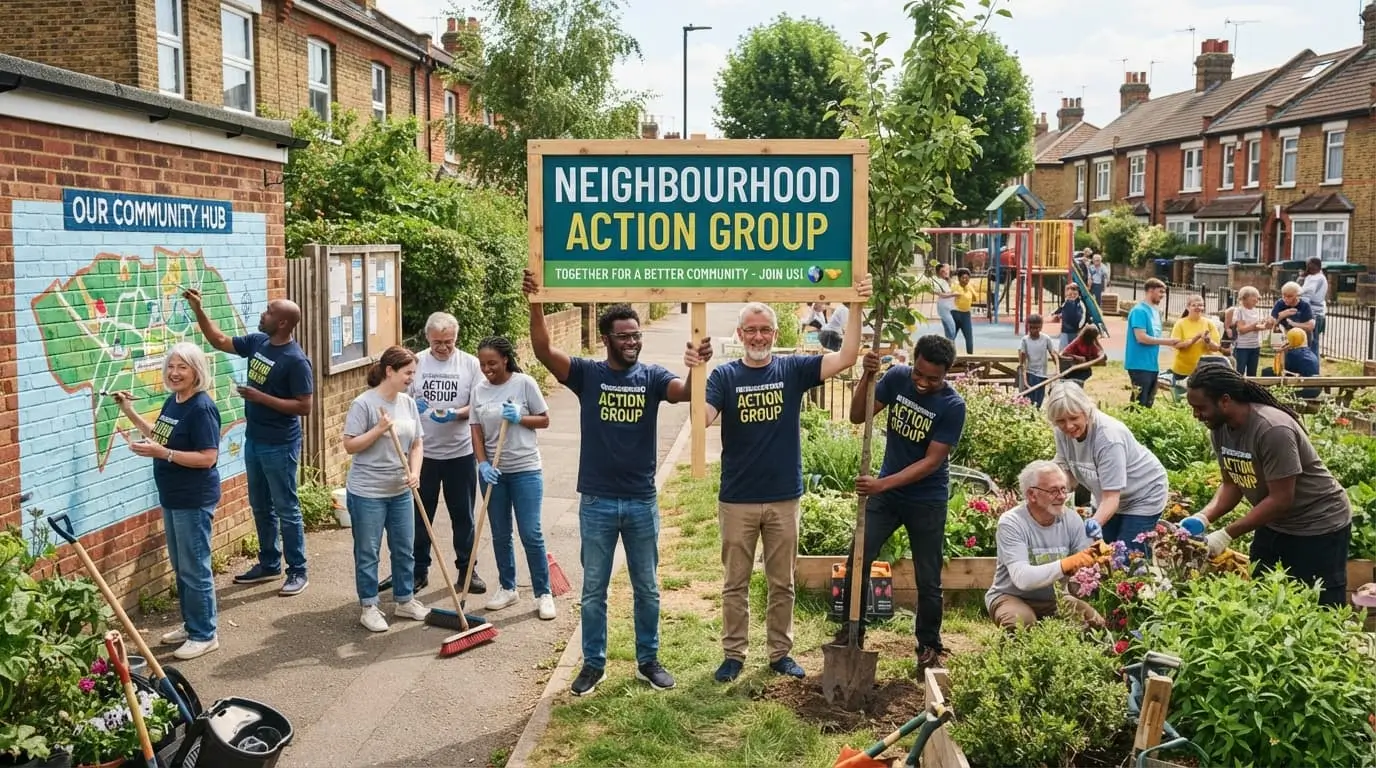
Neighbourhood Action Group: How Local Voices Create Change
- November 27, 2026
- 0
A neighbourhood is more than a collection of streets, houses, shops, parks, and public buildings. It is a shared environment shaped by the people who live, work, study,
A neighbourhood is more than a collection of streets, houses, shops, parks, and public buildings. It is a shared environment shaped by the people who live, work, study,
A neighbourhood is more than a collection of streets, houses, shops, parks, and public buildings. It is a shared environment shaped by the people who live, work, study, and spend time there. Its character depends not only on local services or council decisions, but also on whether residents feel heard, connected, and able to influence the place they call home.
Yet many local concerns are difficult to resolve when people face them individually. A damaged pavement may affect several streets. Poor lighting can make residents feel uncomfortable after dark. Litter, neglected public spaces, traffic problems, antisocial behaviour, and a lack of activities for young people can gradually weaken confidence in an area. People may complain to different organisations without knowing whether others share their concerns or who has the authority to respond.
A Neighbourhood Action Group offers one way to bring those separate voices together. In the traditional UK context, the term is associated with organised local collaboration in which residents and relevant public services discuss neighbourhood priorities, share information, and work towards practical improvements. The exact structure varies between places, but the underlying idea is consistent: local people should have a meaningful opportunity to help identify problems and influence responses.
A successful group is not simply a meeting where complaints are collected. It is a channel for communication, cooperation, and shared responsibility. Its value comes from connecting residents with institutions that can help, while encouraging the community to take part in shaping its own priorities.
The term Neighbourhood Action Group does not describe one nationally uniform organisation with identical membership rules, powers, or meeting arrangements in every town. In the UK, it has been used for local partnership groups associated particularly with neighbourhood policing and community problem-solving.
In this traditional model, residents work alongside neighbourhood police teams and other local partners to identify concerns and agree priorities. Depending on the area, those partners may include council representatives, housing providers, schools, businesses, community organisations, and other public services.
The group provides a practical meeting point between people experiencing local problems and institutions that may have the authority, resources, or specialist knowledge to respond. It can help turn scattered concerns into a shared picture of what needs attention.
The modern UK approach grew alongside wider efforts to make public services more responsive to local concerns. Neighbourhood policing developed in the early 2000s, with an emphasis on visible local policing, stronger relationships with residents, and problem-solving shaped by the needs of individual areas.
Neighbourhood Action Groups became one way of putting that approach into practice. Rather than relying only on formal crime reports or decisions made at a distance, local partnerships could gather residents’ views, identify recurring issues, and discuss possible responses.
The model was not simply about asking residents what worried them. It was also about building a process through which concerns could be prioritised, referred to the right organisation, followed up, and reviewed.
Over time, the name and format have varied. Some places use terms such as local action group, community forum, neighbourhood forum, or partnership meeting. In some areas, a traditional NAG may remain active; elsewhere, similar work may take place through a different local arrangement. The important distinction is the function, not just the label.
A traditional NAG is generally a multi-agency, problem-solving arrangement with community participation. It is not simply a social club, a campaign group, or a meeting of public officials.
Its defining features commonly include:
The group may advise, coordinate, recommend, and help monitor action. It does not automatically possess legal authority to direct the police, instruct a council, allocate public budgets, or compel another organisation to act. Those powers remain with the relevant statutory bodies and decision-makers.
This distinction is central to understanding both the strengths and limitations of the model.
A neighbourhood action group matters because local knowledge and institutional responsibility are different kinds of knowledge. Residents understand how a place is experienced in everyday life. Public agencies understand their legal duties, service procedures, operational constraints, and available resources.
Neither perspective is sufficient on its own.
A council database may record individual reports of fly-tipping, damaged street furniture, or missed collections. Residents may notice that the same location repeatedly becomes a dumping point, that a particular route feels uncomfortable after dark, or that a public space is poorly used because it lacks maintenance.
These observations can help an agency understand the wider context behind individual complaints.
For example, imagine residents repeatedly raising concerns about a poorly maintained footpath. A NAG could help establish whether the problem is limited to surface damage, connected to inadequate lighting, or made worse by overgrown vegetation. The group would not repair the path itself, but it could help clarify the issue and identify which organisation should assess it.
A neighbourhood group can include several organisations, but their roles are not interchangeable.
A council may be responsible for certain public spaces, waste services, roads, or environmental enforcement. Police deal with crime and public safety within their responsibilities. Housing providers manage their own properties and communal areas. Schools and youth organisations may contribute to discussions about activities, support, and local opportunities.
When the right organisation is involved, a discussion is more likely to lead to a practical next step. When responsibility is unclear, the group can help identify where a concern should be referred.
Trust is damaged when residents repeatedly raise the same concern and receive no explanation.
Not every issue can be resolved quickly. Some require funding, investigation, legal processes, or coordination between several agencies. But a group can still communicate what has happened, who is responsible, what obstacles remain, and when an update is expected.
A realistic explanation is more useful than a promise that cannot be kept.
A neighbourhood action group should not become a small circle of familiar voices speaking on behalf of everyone. Its legitimacy depends on whether it makes a genuine effort to hear from the wider area.
Participation can take many forms. Some residents attend meetings regularly, while others contribute through surveys, community events, written feedback, or conversations with representatives.
A group should first understand what people are experiencing. That means collecting views from more than the most vocal residents.
A meeting may reveal concerns about parking or noise, but a survey or street-level conversation may uncover other issues affecting people who do not usually attend public meetings.
Different methods can reach different groups:
The aim is not to collect the largest possible volume of comments. It is to build a fairer picture of the neighbourhood.
Communities often face more concerns than a volunteer group or local partnership can address at once. Prioritisation is therefore essential.
A group might consider how many people are affected, how serious the problem is, whether it is recurring, whether a vulnerable group faces particular difficulties, and which organisation can realistically respond.
It should also explain why some issues are being addressed before others. Without that explanation, prioritisation can appear arbitrary or influenced by whoever speaks most forcefully.
A group that hears mainly from homeowners, long-term residents, or people with flexible schedules may overlook renters, younger residents, shift workers, people with disabilities, and those who face language or transport barriers.
Good representation is not achieved simply by inviting everyone to the same meeting. It requires considering whether the meeting’s time, location, language, format, and atmosphere make participation practical.
A group should also be clear that its members are contributors, not automatically elected representatives of every resident. It can speak about the feedback it has received, but should not claim unanimous support without evidence.
The work of a neighbourhood action group depends on practical contributions rather than titles. Members may have different levels of involvement, but a few shared responsibilities help the group remain credible.
Members should communicate what residents have actually said, while avoiding the suggestion that one personal opinion represents an entire street or community.
Where possible, they should distinguish direct observations from rumours, assumptions, or second-hand accounts.
A concern about a broken streetlight may belong with a council or other responsible provider. A report of immediate danger requires the appropriate emergency response rather than waiting for a scheduled group meeting.
Members can help residents understand where to direct an issue, but should not present the group as a replacement for official reporting channels.
If a member agrees to contact a local organisation, circulate a meeting summary, or gather feedback, they should either complete the task or explain why they cannot.
Small commitments matter. A group that regularly records actions but rarely follows them up can lose public confidence.
Community discussions can involve sensitive subjects, including disputes, safety concerns, family circumstances, and allegations about individuals.
Members should avoid circulating personal details unnecessarily. They should not turn meetings into public forums for naming and shaming neighbours. Serious allegations should be referred through appropriate official channels.
A neighbourhood may contain people with different priorities, backgrounds, and experiences. Members should listen without intimidation, personal attacks, or discrimination.
The group’s role is to understand shared concerns and identify constructive responses, not to create an environment in which residents feel unwelcome for disagreeing.
A priority should be more than a broad complaint. It needs enough detail for the relevant organisation to understand the issue and consider an appropriate response.
Consider an illustrative example: several residents mention speeding on a residential road. One report may describe a vehicle travelling too quickly near a school entrance; another may raise concerns about visibility at a junction.
The group can bring these accounts together, identify the location and times involved, and ask the relevant authority whether further assessment is possible.
This does not establish that a particular road has a confirmed speeding problem. It demonstrates how a group can organise local observations into a clearer issue for consideration.
Local experience is valuable, but it should be considered alongside available information.
Depending on the concern, evidence may include maintenance records, service requests, environmental observations, official reports, consultation feedback, or information provided by the responsible agency.
A lack of formal reports does not necessarily mean that residents have no legitimate concern. It may indicate that people do not know how to report an issue, do not expect a response, or face barriers to using the available process.
A vague priority such as “improve the neighbourhood” is difficult to act on.
A more useful statement might identify a particular public space, explain the issue residents have raised, and name the organisation being asked to assess it.
Specific priorities are easier to review because the group can ask whether an inspection occurred, whether a response was provided, or whether the original concern has changed.
The traditional UK Neighbourhood Action Group model has a strong connection with neighbourhood policing, but community safety is wider than policing alone.
Residents may feel unsafe because of poor lighting, neglected public spaces, traffic conditions, harassment, environmental problems, or a lack of confidence that concerns will be taken seriously. Some issues require police involvement; others are primarily matters for councils, housing providers, transport authorities, or community services.
Recorded incidents provide one part of the picture. People’s feelings about safety provide another.
A public walkway may have few recorded incidents but still feel uncomfortable to residents because it is poorly lit or isolated. Conversely, a highly visible problem may attract repeated discussion even when the available evidence suggests that its scale is limited.
A responsible group should take both evidence and lived experience seriously. It should not dismiss people’s concerns simply because they do not appear in a particular dataset, nor should it present fear or rumour as proof that a crime has occurred.
The physical condition of a neighbourhood affects how people use it.
Well-maintained paths, accessible public spaces, functioning streetlights, clear waste arrangements, and cared-for green areas can make everyday life more pleasant. These improvements may also encourage residents to spend time outdoors and develop stronger connections with their surroundings.
A group might therefore discuss issues such as:
These examples are possible areas of work, not claims about a particular neighbourhood or group.
Community participation does not mean residents should confront suspected offenders, investigate people themselves, or attempt to enforce the law.
A NAG is most constructive when it encourages appropriate reporting, communication, prevention, and cooperation with responsible services. Members should never put themselves or others at risk to gather information or resolve a safety concern.
Meetings help people exchange information, but the real test of a group is whether discussion leads to useful follow-up.
A neighbourhood action group may support several kinds of activity, depending on local priorities and the partners involved.
Residents may identify an underused green area, a neglected entrance to a park, or a public space that needs better maintenance. The group can help clarify responsibility, bring the issue to the relevant organisation, and encourage residents to contribute appropriate feedback.
Some improvements may involve formal maintenance. Others may be supported by voluntary activities, such as a community planting day, provided the work is safe and properly coordinated.
A neighbourhood can have many organisations without residents knowing how to find them. Community centres, libraries, youth clubs, local charities, sports groups, and advice services may all provide useful support.
A group can help make these connections more visible by sharing verified information and encouraging organisations to communicate with one another.
Residents may not know which council department handles a particular issue or how to raise a concern with a housing provider. A group can help explain the available routes and direct people towards official channels.
It should not promise outcomes on behalf of those organisations. Its role is to improve communication and make the process easier to navigate.
Young residents experience neighbourhoods differently from older adults. They may have views about transport, recreation, public spaces, school routes, online communication, and opportunities to take part in local activities.
A group that wants to understand the whole community should create suitable ways for younger people to contribute. That could include age-appropriate consultation through schools or youth organisations, rather than expecting every young person to attend a formal evening meeting.
Youth participation should be respectful and safe. Young people should not be asked to handle sensitive disputes or take responsibility for enforcement.
A group can have committed volunteers and supportive partners but still struggle if residents do not know what it is doing.
Communication should be regular, accessible, and honest. It should explain how people can contribute, what issues are being discussed, and what has happened since the previous update.
Meeting summaries can help residents understand which issues were raised, what priorities were agreed, and which organisations have been asked to respond.
The summaries should avoid publishing personal details or sensitive information. They should focus on the issue, the agreed next step, and any update that can responsibly be shared.
Not everyone is comfortable speaking at a public meeting. Some residents may prefer email, a paper survey, an online form, or a conversation with a community representative.
Digital communication can make participation easier, but it should not become the only route. People with limited internet access, language barriers, disabilities, or different communication preferences should not be excluded.
For general background on how digital communication supports shared interests and organised communities, readers can also explore WorldMagazine.blog’s article on community-based communication and digital identity. The wider lesson is that communication tools are most useful when they help people connect without replacing meaningful conversation.
Residents should be able to understand who participates in the group and what role those people hold.
A simple public explanation of the group’s purpose, membership approach, meeting arrangements, and contact route can reduce confusion. It can also help prevent an informal group from being mistaken for an elected council body or an official enforcement authority.
The phrase Neighbourhood Action Group is sometimes used loosely. However, it is useful to distinguish the traditional model from other organisations that may operate in the same area.
A traditional NAG is generally a multi-agency, problem-solving group with local residents involved. In the UK neighbourhood-policing context, it has often focused on community-identified priorities relating to safety, local conditions, and quality of life.
Its particular value is the connection between residents and relevant public or community partners.
A residents’ association is usually organised around the interests of people living in a particular housing development, street, estate, or neighbourhood.
It may focus on property management, local facilities, planning proposals, maintenance, parking, shared spaces, or representing residents’ views to landlords and public bodies.
Some residents’ associations work closely with NAGs, but their purposes are not identical. A residents’ association may represent a defined group of households, while a traditional NAG may bring together residents and several agencies to address wider local priorities.
Neighbourhood Watch is primarily associated with crime prevention, community awareness, and communication about local safety.
Participants may share appropriate safety information, encourage prevention measures, and report concerns through official channels. A Watch scheme does not normally have the same multi-agency problem-solving role as a traditional NAG.
The two can complement one another. A Watch scheme may help residents communicate safety concerns, while a NAG may provide a wider forum in which relevant organisations can discuss responses.
Local government committees are formal parts of a council’s decision-making or scrutiny arrangements. Their membership, procedures, responsibilities, and authority are determined by the relevant governance framework.
A NAG is not automatically a council committee. It may advise, raise concerns, or help coordinate action, but it cannot claim council powers simply because council officers or councillors attend its meetings.
| Organisation | Main purpose | Typical relationship with residents |
|---|---|---|
| Neighbourhood Action Group | Local problem-solving through community and agency partnership | Residents help identify and prioritise concerns |
| Residents’ association | Representing local residents’ shared interests | Members raise issues affecting their homes or area |
| Neighbourhood Watch | Community safety awareness and prevention | Neighbours share appropriate safety information |
| Local government committee | Formal council business, scrutiny, or decisions | Public participation depends on council rules |
The distinctions are important because residents should know whether a group can make decisions, provide recommendations, coordinate activity, or simply pass concerns to another organisation.
Good intentions do not guarantee lasting results. Neighbourhood groups often rely on volunteers who have limited time, varying experience, and no direct control over the resources needed to resolve every concern.
A small number of committed people may end up organising meetings, writing updates, contacting agencies, and following up actions.
Over time, the workload can become difficult to sustain. If responsibilities are not shared, the group may depend too heavily on one or two individuals.
A practical response is to divide tasks into manageable roles, keep records, and make it easy for new volunteers to contribute without taking on an overwhelming commitment.
Some residents are more confident about speaking in public or contacting officials. Others may feel that their views are unlikely to matter.
A group should avoid treating attendance as the only measure of engagement. It should consider who is missing from the conversation and whether its approach makes participation accessible.
A NAG may identify a problem but lack the power to resolve it directly.
For example, a group may agree that a road needs a safety assessment, but the relevant transport authority must decide what action is possible. Similarly, a housing concern may need to be handled by the responsible landlord.
This can frustrate residents, particularly when an issue remains unresolved. Clear explanations about responsibility and decision-making can help manage expectations.
One street may be concerned about parking while another wants attention given to vandalism or public-space maintenance. Different age groups and households may have different ideas about what should happen first.
A fair process needs transparent criteria and a willingness to explain decisions. The objective is not to make every resident agree on everything, but to establish a reasonable and reviewable set of priorities.
Some improvements require funding, staff time, specialist assessment, or formal approval. A volunteer group cannot create those resources simply by agreeing that an issue matters.
It can, however, help establish why an issue deserves attention, identify potential partners, and communicate what residents are asking for.
When a group makes promises that are outside its control, disappointment can undermine its reputation.
It is better to say that a concern has been referred and is awaiting a decision than to announce that a solution is guaranteed. Honest updates help residents understand the difference between an action taken by the group and an outcome delivered by another organisation.
Community improvement is not always easy to measure. Some results are visible, such as a repaired public facility or a cleaner shared area. Others involve changes in communication, participation, or residents’ confidence.
A useful evaluation considers both practical outcomes and the quality of the process.
A group should record what it agreed to do, who is responsible for following up, and whether an update has been received.
This creates a clearer picture than counting the number of meetings held. A group could meet frequently without resolving or advancing any of the issues residents have raised.
Neighbourhood concerns are not fixed. A problem may improve, become less urgent, or be replaced by a new issue.
Regular reviews help the group avoid continuing to focus on a priority simply because it appeared on an earlier list.
Feedback can reveal whether people understand the group’s role, know how to contribute, and receive useful updates.
A group should not assume that silence means satisfaction. Residents may stop participating because they feel ignored or do not know how to get involved.
Depending on the issue, useful indicators might include:
No single measure tells the whole story. A balanced review combines available records with community feedback and a realistic understanding of what the group can influence.
The process will depend on local arrangements. In some places, an established group may already exist under a different name. In others, residents may need to contact the neighbourhood policing team, parish or town council, local authority, or community partnership to ask what engagement arrangements are available.
Before organising a meeting, residents should identify the kind of issues they want to discuss and whether an existing forum already covers them.
A group should have a manageable purpose. Trying to address every social, environmental, and administrative issue at once can make it difficult to establish priorities.
The right partners depend on the subject. A discussion about local safety may involve neighbourhood policing. A concern about public spaces may require council involvement. Housing issues may need the relevant landlord or housing provider.
It is better to invite organisations because their responsibilities are relevant than to create a large meeting with no clear reason for each participant to attend.
Members should understand how meetings are organised, how priorities are selected, how actions are recorded, and how sensitive information is handled.
A simple written outline can help avoid confusion. It should explain the group’s purpose and limitations, rather than imply that it has powers it does not possess.
A group should not become closed after its first few meetings. It needs a continuing way for residents to raise concerns, receive updates, and comment on priorities.
The process should be open enough for new voices to join and practical enough for volunteers to sustain.
For a wider look at how local interests and opportunities can be communicated to different audiences, WorldMagazine.blog’s guide to youth and career-focused community resources offers an adjacent perspective on the value of making opportunities easier to discover. It is not a guide to setting up a NAG, but it illustrates why accessible information matters when trying to involve people who might otherwise be overlooked.
Neighbourhood groups are likely to continue adapting as local communities change. Housing patterns, population movement, online communication, public-service pressures, and environmental concerns all influence what residents expect from local institutions.
The basic need for a meaningful way to raise shared concerns, however, remains important.
Online meetings, digital surveys, email updates, and community messaging can make it easier for residents to contribute when they cannot attend in person.
These tools can also help groups share meeting summaries and explain which issues are being considered.
But digital access is uneven. A group that relies entirely on online communication may exclude residents who have limited connectivity, lower digital confidence, or accessibility needs. The strongest approach combines online options with face-to-face contact and other accessible methods.
Some local concerns require a mix of expertise. Improving a public space may involve residents, council services, environmental teams, housing providers, and voluntary organisations.
Groups can become more effective when they bring the relevant partners together around a clearly defined issue rather than expecting every organisation to attend every meeting.
Future neighbourhood collaboration should consider the experiences of younger residents. Their views on public spaces, transport, recreation, education, and local opportunities can help groups understand how an area is changing.
Participation should be age-appropriate and supported by trusted organisations. Young people should be invited to contribute ideas without being expected to take on adult responsibilities or handle potentially unsafe situations.
Residents are more likely to remain involved when they can see that their contributions are taken seriously.
Not every concern will lead to immediate change. But clear explanations, honest progress updates, and evidence of completed actions can make the process feel worthwhile.
A group that listens, communicates, and acknowledges its limitations may have a more lasting influence than one that makes ambitious promises without a practical route to delivery.
Its main purpose is to bring residents and relevant local organisations together to identify shared concerns and work towards practical improvements. In the traditional UK model, this often includes neighbourhood safety, antisocial behaviour, environmental concerns, and local quality-of-life issues. The group provides a way to discuss priorities, coordinate responses, and review progress.
Not necessarily. The traditional model has often operated as a local partnership associated with neighbourhood policing and public-service collaboration. A group may include police representatives, council officers, residents, and other organisations, but that does not automatically make it a government department or statutory council committee. Its exact status depends on the local arrangement.
Membership arrangements vary, but residents who care about local issues may be able to participate. Traditional groups can also include representatives from neighbourhood policing teams, local councils, housing providers, schools, businesses, and voluntary organisations. Some groups may have a defined membership process, so interested residents should check with the relevant local organisers.
A residents’ association generally represents the interests of people living in a particular neighbourhood, housing development, or residential area. A traditional NAG is more specifically focused on partnership-based problem-solving and may bring several public services together with residents. The two can cooperate, but their responsibilities and structures are not necessarily the same.
A NAG does not automatically have authority to direct a council, instruct police officers, or make legally binding public decisions. It can identify local priorities, share information, recommend action, and help coordinate responses. Formal decisions remain with the organisations and authorities that hold the relevant legal responsibilities.
Depending on its local purpose, a group may discuss speeding, parking, graffiti, fly-tipping, vandalism, antisocial behaviour, neglected public spaces, environmental maintenance, and concerns about community safety. It may also help identify communication gaps between residents and public services. Issues should be directed to the organisation responsible for handling them.
Residents can ask their local neighbourhood policing team, parish or town council, local authority, or community partnership whether a NAG or similar forum operates in their area. Some communities use different names, such as neighbourhood forums or local action groups. The important thing is to find the correct local contact and understand the group’s current arrangements.
Priorities are usually informed by residents’ feedback, local observations, and information shared by relevant partner organisations. Groups may consider how serious an issue is, how many people it affects, whether it is recurring, and which organisation can respond. A fair process should explain why certain issues are prioritised and provide opportunities for the wider community to contribute.
Yes, where appropriate arrangements make participation safe and meaningful. Young residents can contribute perspectives about public spaces, transport, recreation, education, and local opportunities. Schools, youth organisations, and community groups may help create suitable ways for them to share their views. They should not be expected to investigate incidents, confront people, or take on enforcement responsibilities.
Residents can look at whether the group communicates regularly, represents a broad range of local views, records agreed actions, and provides updates. Practical progress may include a concern being assessed by the correct organisation, a maintenance issue being resolved, or communication becoming clearer. Effectiveness should be judged by meaningful outcomes and community feedback, not simply by how often meetings take place.
A Neighbourhood Action Group represents a practical idea: the people who experience a neighbourhood every day should have a meaningful opportunity to help shape its future. Their knowledge can reveal problems that formal systems overlook, while cooperation with public institutions can turn local observations into realistic action.
The traditional UK model demonstrates the value of bringing residents, neighbourhood policing teams, councils, and other partners into a shared problem-solving process. It also highlights an important boundary. A group can coordinate, advise, represent concerns, and encourage progress, but it cannot replace the legal responsibilities of public authorities or guarantee that every request will be fulfilled.
Its success depends on more than enthusiasm. Fair representation, clear communication, realistic priorities, respect for privacy, and consistent follow-up are all essential. Volunteers need manageable responsibilities, institutions need to explain their decisions, and residents need accessible opportunities to contribute.
A strong neighbourhood is not one in which everyone agrees on every issue. It is one where differences can be discussed constructively, concerns are taken seriously, and people understand how decisions are made. Community participation becomes meaningful when it is connected to action and supported by honest relationships.
Ultimately, a Neighbourhood Action Group is valuable not because its name promises change, but because it can create a practical space in which local knowledge and institutional responsibility meet. When residents are heard and organisations respond transparently, shared responsibility can become a lasting foundation for safer, more connected, and more confident communities.
For More Visits: Worldmagazine