


Pappedeckel: Meaning, Origins and German Usage
- September 30, 2026
- 0
Some words become interesting precisely because they seem ordinary at first glance. Pappedeckel is one of those words. It looks unmistakably German, yet its meaning can be difficult
Some words become interesting precisely because they seem ordinary at first glance. Pappedeckel is one of those words. It looks unmistakably German, yet its meaning can be difficult
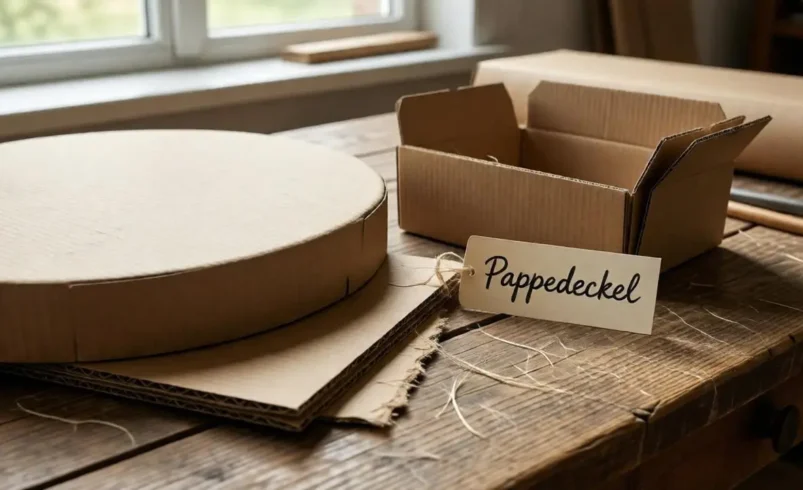
Some words become interesting precisely because they seem ordinary at first glance. Pappedeckel is one of those words. It looks unmistakably German, yet its meaning can be difficult to pin down if it is encountered without context. An English speaker might instinctively break it into familiar pieces and assume it means a cardboard lid. A German speaker from another region may recognize a related form immediately, while someone from a different part of the German-speaking world may use another spelling altogether.
The confusion becomes even more interesting because the word belongs to a broader family of German expressions associated with Pappe, meaning cardboard or a stiff paper-based material, and Deckel, a word commonly associated with a lid or cover. The standard forms Pappdeckel and Pappendeckel are especially important when trying to understand what Pappedeckel means.
In its most useful everyday sense, the word refers to a piece of cardboard or a cardboard-related cover. Depending on the situation, it may be translated into English as “cardboard,” “piece of cardboard,” “cardboard cover,” “pasteboard,” or “cardboard lid.” The surrounding context matters more than a rigid one-word translation.
There is also a linguistic story behind the term. Pappedeckel illustrates how German compound words can develop meanings that are broader than their individual components, and how regional speech can preserve forms that differ from the vocabulary most familiar from formal written German. That makes the word interesting not only as a term for a material or object, but as a small example of how language changes from one community to another.
| Fact | Details |
|---|---|
| Term | Pappedeckel |
| Meaning | A cardboard or paperboard piece, cover, or related cardboard object, depending on context |
| Language | German, particularly associated with regional or colloquial usage |
| Origin / Background | Connected with the German words Pappe and Deckel |
| Category | German vocabulary and regional expression |
| Common Use | Describing a piece of cardboard, cardboard cover, or similar flat cardboard object |
| Related Terms | Pappdeckel, Pappendeckel, Pappe, Deckel |
| Typical Context | Everyday speech, regional German, packaging, covers, practical descriptions of cardboard |
| Material / Form | Cardboard, pasteboard, paperboard, or another stiff paper-based material |
| Historical Context | Part of the German vocabulary surrounding paper-based materials and covers |
| Modern Usage | Still understandable in German-related contexts, with the exact form and meaning influenced by region and situation |
| Cultural Relevance | Illustrates German compound-word formation and the survival of regional vocabulary |
The first mistake a reader can make with Pappedeckel is assuming that every appearance of the word must refer to exactly the same physical object.
Language rarely works that neatly.
If someone is talking about a sheet of cardboard being used to protect a surface, “piece of cardboard” may be the most natural English interpretation. If the conversation concerns the top of a box, “cardboard lid” could make more sense. If the word appears in a bookbinding context, “cardboard cover” or “pasteboard” may communicate the idea more accurately.
This is why translating Pappedeckel requires attention to the surrounding sentence.
The word is closely related to the established German form Pappdeckel, which is used for a piece of cardboard. Pappendeckel is another recognized form. The spelling Pappedeckel can therefore be understood as belonging to this wider word family rather than as the name of a completely separate modern product.
That distinction is important.
Someone searching for Pappedeckel might expect to discover a particular type of packaging, a brand, a manufactured product, or a technical material. It is better understood as a vocabulary term connected with cardboard and cardboard objects.
Once that becomes clear, the rest of the word makes considerably more sense.
German is particularly famous for compound nouns. Words can be joined together to describe an object with considerable precision.
Pappedeckel is easier to understand when viewed through the related form Pappdeckel.
The first element is connected to Pappe, the German word for cardboard or a relatively stiff paper-based material. Pappe is thicker and more substantial than ordinary paper and can be used for packaging, covers, backing material, craft projects, and other practical purposes.
The second element is Deckel.
Deckel generally refers to a lid, cover, or closing component. It can be used for the top or closure of a container, box, case, or other object. The word can also occur in contexts involving covers more generally.
Put together, the basic idea becomes intuitive:
Pappe + Deckel
The literal structure points toward something like a cardboard cover or cardboard lid.
But there is an important linguistic lesson here. Compound words do not always behave like mathematical equations. The meaning of the complete word can become broader than a strict translation of its individual parts.
That is why Pappdeckel can refer to a piece of cardboard rather than only something that functions as a lid.
For English speakers, this is one of the most useful things to understand about the word.
There is no single English translation that works perfectly in every situation.
The most neutral translation is often piece of cardboard.
Other possibilities include:
The best choice depends on the object being discussed.
Imagine someone placing a flat piece of cardboard beneath a household object. Calling it a “cardboard lid” would sound strange because it is not serving as a lid. “Piece of cardboard” would be more natural.
Now imagine someone describing the removable top of a cardboard box. In that setting, “cardboard lid” might be the clearest translation.
A bookbinding discussion creates another possibility. A stiff board used to form a book cover may be better described as a cardboard or pasteboard cover.
This flexibility explains why online translations can sometimes appear inconsistent. Different translations may actually be describing different uses of the same underlying word family.
The problem is not necessarily that one translation is wrong. The problem is that English does not have one universally appropriate word that reproduces every contextual meaning.
Spelling is one of the most important parts of understanding this term.
Readers may encounter:
Pappedeckel
Pappdeckel
Pappendeckel
These forms look extremely similar, and they are closely connected in meaning.
Pappdeckel is the form most useful when discussing the standard German word for a piece of cardboard. Pappendeckel is another recognized form. Pappedeckel can appear in regional, colloquial, or dialect-related contexts.
This does not mean that three completely unrelated objects are being described.
Instead, the differences demonstrate something common in German-speaking regions: everyday speech does not always follow the exact spelling used in formal dictionaries.
Regional vocabulary can preserve older pronunciations, insert or remove sounds, or develop local forms that feel completely natural to speakers from one area.
For someone learning German, this can initially be frustrating.
For someone interested in language, however, it is one of the most interesting parts of the subject.
German is not one perfectly uniform spoken language.
There is standard German, often called Hochdeutsch, but there are also numerous regional varieties and dialects. Southern Germany, Switzerland, Austria, and parts of the southwest have linguistic traditions that can differ considerably from the German heard in northern cities.
Pappedeckel fits into this larger story of regional variation.
In some southwestern German-speaking areas, related forms can appear in local vocabulary. Different pronunciations may transform consonants or vowels, producing spellings that look unfamiliar to someone accustomed to standard German.
One regional form can resemble Pappedeckel while another may look considerably different.
This is why spelling alone should not always be used to determine whether two expressions are unrelated.
The same phenomenon appears throughout German dialect vocabulary. A word that sounds completely normal in one town can seem old-fashioned, humorous, or unfamiliar somewhere else.
Pappedeckel is therefore more than a cardboard-related term. It provides a small window into the relationship between standard language and regional speech.
To understand the practical meaning of Pappedeckel, it helps to understand what Pappe represents.
Cardboard occupies an interesting place between paper and rigid construction material.
It begins with paper fibers but is produced in a form that provides considerably more thickness and stiffness than ordinary writing paper. Depending on how it is manufactured, cardboard can be light and flexible or relatively thick and rigid.
This makes it useful for an enormous range of everyday objects.
Boxes depend on paperboard and cardboard. Packaging uses it for structural support. Book covers can contain thick board. Crafts use it because it can be cut, folded, painted, glued, and shaped. Protective layers can be made from it because it provides separation without the weight of wood or metal.
A Pappedeckel therefore does not have to represent a sophisticated engineered product.
Its usefulness comes from a very simple combination of properties: it is relatively light, easy to handle, inexpensive compared with many rigid materials, and capable of being shaped for different purposes.
The most intuitive practical application is packaging.
A cardboard container may need a separate cover to protect what is inside. Depending on its construction, that cover might be folded, fitted, glued, or simply placed over the container.
The same general idea appears in boxes used for storage, shipping, food packaging, stationery, and household products.
Cardboard covers are also useful because they can be printed.
A manufacturer can place instructions, branding, illustrations, warnings, or product information directly onto the surface. This turns a simple protective material into part of the communication surrounding a product.
That is one reason cardboard has remained important despite the availability of plastics and other synthetic materials.
It combines structure with a surface that can easily carry printed information.
Another useful context is bookbinding.
Traditional book construction has long used stiff boards as part of the cover. These boards provide structure and protect the pages from bending or damage.
Depending on the construction, a cardboard-like board may sit beneath a paper, cloth, leather, or synthetic covering.
In this setting, translating a cardboard-related German term as simply “cardboard” may not fully communicate its purpose.
The material is important, but so is its function.
It is part of the protective structure of the book.
This illustrates an important principle when translating Pappedeckel: the object should be considered in context rather than treated as an isolated vocabulary entry.
Yes, depending on context.
The presence of Deckel naturally creates the association with a lid or cover. A cardboard lid is therefore a perfectly reasonable interpretation when the word is being used to describe a cardboard closure.
But it should not automatically be assumed that every Pappedeckel is a lid.
This distinction may appear minor, but it matters for accurate translation.
Suppose a German speaker describes a rectangular piece of cardboard used underneath something. The material is the relevant characteristic, not the object’s role as a closure.
Calling that object a “cardboard lid” would add a function that may not exist.
This is one of the most common problems with literal translation: the individual pieces of a compound word can encourage a narrower interpretation than the actual usage supports.
Pappedeckel demonstrates why German compound nouns should sometimes be approached as complete vocabulary items.
English also has compounds such as “bookshelf,” “raincoat,” and “toothbrush.” A toothbrush is not simply a “brush associated with teeth” in every imaginable sense; it is a specific object whose meaning has become conventional.
German compounds can become much longer and can combine words in ways that initially seem transparent but still require contextual understanding.
Pappdeckel appears relatively simple, but it demonstrates the same principle.
Understanding Pappe and Deckel helps a great deal. It does not necessarily eliminate the need to understand how the complete word is used.
This is particularly important for language learners who try to translate unfamiliar compounds one component at a time.
Sometimes that method works beautifully.
Sometimes it gets you close to the answer without actually giving you the answer.
Regional language can create another layer of complexity.
In some Alemannic or southwestern German contexts, closely related dialect forms can have an additional colloquial association with a driver’s license.
This is an excellent example of why regional context matters.
A learner who knows only the literal cardboard-related interpretation might hear a dialect speaker use a related expression and become completely confused. The words appear to refer to cardboard, yet the conversation seems to concern an official document.
The explanation is linguistic rather than physical.
A physical document made of paper or cardboard can acquire a nickname based on its appearance or material. Over time, that nickname can become familiar within a particular speech community.
This should not be generalized to all German speakers.
It is better understood as a regional use of related vocabulary.
That distinction prevents a common mistake: taking one dialect meaning and presenting it as though it were the universal definition of Pappedeckel throughout the German-speaking world.
One reason words like Pappedeckel are interesting is that they often belong to ordinary life rather than formal institutions.
People need names for boxes, lids, covers, sheets, containers, tools, household objects, and materials. Much of everyday vocabulary develops around precisely these practical needs.
Such words may never become internationally famous.
They do not need to.
Their purpose is to allow people in a community to understand one another quickly.
A regional word can be particularly efficient for people who grew up hearing it. There is no need to explain its history every time it is spoken.
That efficiency is one reason dialect vocabulary can survive for generations.
Even when younger speakers increasingly use standard German, familiar local words can remain in informal conversation.
Unusual regional words can preserve something that standardized language sometimes loses: a sense of place.
A word can tell you something about where a person grew up, which generation they belong to, or what kind of everyday speech they are accustomed to hearing.
This is not unique to German.
Every language contains regional terms that may sound perfectly ordinary to local speakers but unusual to outsiders. Some refer to food, some to tools, some to clothing, and others to simple household objects.
Pappedeckel belongs to this fascinating category because the basic concept is so ordinary.
Cardboard is everywhere.
Yet the way people name it can reveal regional linguistic habits.
That makes the term a small example of a larger truth about language: ordinary objects often have surprisingly rich vocabulary histories.
Readers interested in how everyday vocabulary connects with language and culture can find related cultural material through World Magazine, where language, traditions, and regional stories can be explored from broader perspectives.
| Term | Meaning | How It Differs |
|---|---|---|
| Pappedeckel | Regional or colloquial form associated with cardboard or a cardboard piece/cover | Spelling and use can vary regionally |
| Pappdeckel | A piece of cardboard or related cardboard cover | More established standard German form |
| Pappendeckel | A cardboard piece or similar object | Another recognized form in German |
| Pappe | Cardboard or stiff paper-based material | Refers to the material rather than the complete compound |
| Deckel | Lid, cover, or closing part | Describes the covering component more generally |
| Karton | Cardboard/carton or a cardboard container, depending on context | Broader term with several common uses |
| Bierdeckel | Beer coaster | A specific cardboard or absorbent coaster associated with drinks |
The final term in the table is especially useful because it demonstrates how German compounds can become highly specific.
Bier means beer, while Deckel can suggest a cover. Yet Bierdeckel does not normally mean a “beer lid.” It refers to a beer coaster.
This is a perfect reminder that translating compounds word by word can sometimes produce a misleading result.
Because both words can involve cardboard and everyday drink settings, confusion is possible.
A Bierdeckel is specifically associated with placing a drink on a coaster. It has a recognizable social and commercial context in German-speaking countries.
Pappedeckel is broader.
If someone uses a cardboard piece for a completely different purpose, Bierdeckel would be inaccurate.
Likewise, a cardboard object that happens to be beneath a glass does not automatically become a Bierdeckel simply because it is made of cardboard.
Function matters.
This is one of the simplest ways to understand German vocabulary: material, shape, purpose, and context can all influence the word chosen.
Consider the phrase “cardboard lid.”
It sounds perfectly logical as a translation of the components behind Pappdeckel.
But imagine a sentence describing a flat piece of cardboard being placed beneath an object. “Cardboard lid” would suddenly become misleading.
The problem is not the dictionary.
The problem is assuming that a compound’s literal components always determine its complete meaning.
Translation requires judgment.
A good translator asks what the speaker is describing, what the object does, and how an English speaker would naturally express the same idea.
That is why “piece of cardboard” is often a safer general interpretation than “cardboard lid.”
It does not unnecessarily assign a function to the object.
A word like Pappedeckel is easiest to understand when placed into realistic situations.
Imagine someone working on a craft project and asking for a firm piece of cardboard to place underneath a model. In English, the natural request would probably be “Can you give me a piece of cardboard?”
In a packaging environment, someone might refer to a cardboard cover that fits over a container. There, “cardboard lid” becomes more appropriate.
In bookbinding, the same material may be discussed as a board used in a cover.
The underlying concept remains related, but the English expression changes.
This is why a person learning German should resist the temptation to memorize only one English equivalent.
It is more useful to remember the conceptual meaning and then learn how context determines the translation.
For English speakers, pronunciation can be another source of uncertainty.
The standard form Pappdeckel can be approximated in English as something like “pap-dek-el,” although this does not reproduce every detail of German pronunciation.
Regional forms may sound different.
Dialects can alter vowels, consonants, endings, and rhythm. A person who has only encountered the written word may therefore fail to recognize it when hearing a regional speaker use a related form.
This is common with dialect vocabulary.
Written German gives learners a useful foundation, but spoken regional German can reveal a much wider linguistic landscape.
Pappedeckel is a good example because even the spelling itself can vary.
No, not in the sense of one specific branded product or standardized consumer item.
This distinction is useful because online searches sometimes make ordinary words look like product names.
Pappedeckel is fundamentally a term associated with cardboard and cardboard-related objects.
A company could manufacture a product that fits the description, such as a cardboard cover or packaging component, but the word itself does not identify one particular manufacturer or commercial product.
This also means there is no single design that every Pappedeckel must have.
Thickness, size, shape, stiffness, coating, and construction can all vary according to purpose.
No.
Cardboard is a broad material category.
A thin piece can be flexible enough to bend easily. A thicker board can be stiff and resistant to deformation. Some cardboard surfaces are smooth and printable, while others are rough or unfinished.
A cardboard cover may be rectangular, square, circular, or custom-shaped.
Packaging manufacturers routinely cut paperboard into complicated forms that fold into boxes, sleeves, inserts, and closures.
Therefore, Pappedeckel should not be imagined as one standardized object.
The common thread is the cardboard-related material or function, not a universal shape.
The continued usefulness of cardboard helps explain why vocabulary surrounding it remains relevant.
Cardboard is lightweight compared with many rigid materials. It can be manufactured at different thicknesses and converted into a huge range of forms.
It can also be printed, folded, cut, glued, layered, and recycled through appropriate systems.
Those characteristics have made paperboard and cardboard central to packaging and everyday manufacturing for generations.
Even as materials and technologies change, basic cardboard components remain familiar.
A word connected with cardboard therefore does not necessarily belong to the past.
Its exact form may sound regional or old-fashioned to some speakers, but the physical material remains part of modern life.
Perhaps the most interesting part of Pappedeckel is not the cardboard itself.
It is the relationship between standard German and regional speech.
A dictionary tends to give a stable spelling and definition.
Real communities are less tidy.
People shorten words, change sounds, preserve older expressions, borrow from neighboring dialects, and develop humorous or practical nicknames. A word can remain recognizable while gradually changing form.
Pappedeckel sits within that process.
Someone familiar with Pappdeckel may immediately recognize Pappedeckel as a related form. Another speaker may use a completely different regional version.
Neither situation means that one speaker understands German correctly while the other does not.
It demonstrates that language is a living system.
A regional word survives when speakers continue finding it useful.
Sometimes the usefulness is practical. A short word may describe something familiar more efficiently than a formal alternative.
Sometimes the word survives because of family habits.
A child hears grandparents use a particular expression, adopts it, and later uses it with friends or relatives.
Sometimes words survive because they carry identity.
Using a regional word can subtly communicate where someone comes from or which linguistic community they belong to.
Pappedeckel is therefore interesting precisely because it is not an internationally famous term.
Its value lies in its ordinariness.
It shows how language can preserve local ways of describing everyday things.
That is the most obvious interpretation from the word’s components, but the broader meaning can be a piece of cardboard.
The word is connected to cardboard or paperboard. It does not automatically describe a unique technical substance with one fixed composition.
They should not automatically be treated as names for completely different products.
A speaker’s location can influence pronunciation, spelling, and even additional colloquial meanings.
“Cardboard,” “piece of cardboard,” “cardboard cover,” and “cardboard lid” can all be appropriate in different contexts.
Pappedeckel is primarily a vocabulary term associated with German and regional German usage. It should not be treated as a person’s biography or a named celebrity.
Words connected with ordinary materials are often overlooked because they appear too simple to deserve attention.
Yet everyday vocabulary can be remarkably revealing.
A term such as Pappedeckel brings together material culture and language. The object itself belongs to ordinary life: cardboard, covers, packaging, sheets, and practical household materials.
The vocabulary surrounding that object reflects how people historically interacted with materials.
This is particularly interesting in a language such as German, where compound nouns make it possible to create highly descriptive words from familiar components.
The result is a vocabulary that often tells you something about how speakers conceptualize an object.
The word may seem small.
The linguistic idea behind it is not.
For someone learning German, Pappedeckel can be a useful lesson in several areas at once.
First, it demonstrates compound nouns.
Second, it shows why dictionary forms and regional speech are not always identical.
Third, it illustrates contextual translation.
Fourth, it shows how vocabulary can carry geographical information.
A learner who encounters the word in a text should first identify the context. Is someone discussing cardboard? A cover? Packaging? A regional expression?
Once that is clear, the appropriate translation becomes much easier.
This approach is more effective than memorizing “Pappedeckel = cardboard lid” and using that translation everywhere.
The physical concept is simple.
The language around it is not.
That contrast explains why the word attracts curiosity.
A person searching for Pappedeckel may initially expect a simple dictionary definition. Instead, they discover spelling variations, compound-word structure, regional speech, contextual translation, and different possible English equivalents.
The word becomes a miniature lesson in how languages work.
It also demonstrates why unusual terms should not automatically be treated as mysterious inventions or newly created internet vocabulary.
Sometimes an unfamiliar word is simply an ordinary regional expression that has traveled beyond its original linguistic environment.
Pappedeckel is associated with cardboard, paperboard, or a piece of cardboard. Depending on context, it can also refer to a cardboard cover or lid.
Yes. It belongs to a German word family associated with cardboard and covers. The closely related forms Pappdeckel and Pappendeckel are particularly important for understanding its standard usage.
The safest general translation is “piece of cardboard.” Depending on context, “cardboard,” “cardboard cover,” “pasteboard,” or “cardboard lid” may be more natural.
The word can be understood through the combination of Pappe, associated with cardboard, and Deckel, associated with a lid or cover. However, the complete word can have a broader meaning than the literal combination suggests.
Pappdeckel is an established German form associated with a piece of cardboard, while Pappedeckel can occur as a regional or colloquial form. They belong to the same closely related word family.
Pappendeckel is another German form associated with a piece of cardboard or similar cardboard material. It is closely related to Pappdeckel.
A rough English approximation is “pap-dek-el.” The exact pronunciation should be learned from German speech, particularly when dealing with regional forms.
The broader cardboard-related vocabulary is German, but the exact spelling and pronunciation of Pappedeckel can be regional. Standard and dialect forms do not necessarily appear with equal frequency everywhere.
Yes. Closely related dialect forms in parts of southwestern German-speaking areas can have additional colloquial uses, including associations with a driver’s license. Such meanings should be understood as regional rather than universal German usage.
Yes. The cardboard-related concept remains completely relevant because cardboard and paperboard continue to be used in packaging, covers, crafts, and many everyday products. The specific spelling may feel more regional depending on the speaker and location.
Pappedeckel is a useful reminder that language is rarely as simple as a dictionary entry makes it appear.
At its core, the word belongs to the vocabulary surrounding cardboard and covers. Its relationship with Pappe and Deckel makes its basic structure relatively easy to understand, yet its practical translation depends on context. A flat piece of cardboard, a cover, and a lid can all occupy slightly different roles even when they belong to the same linguistic family.
The spelling also opens a door into regional German. Pappdeckel, Pappendeckel, and Pappedeckel demonstrate how closely related forms can exist alongside one another, particularly when everyday speech and formal written language develop differently.
That is what makes an ordinary word like Pappedeckel worth examining.
It is not famous because it names a revolutionary invention or an exclusive product. It is interesting because it shows how people name the ordinary things around them. Cardboard is simple. Language is not. Between those two facts sits the entire story of Pappedeckel.
Understanding the term therefore means doing more than translating a word. It means recognizing the role of context, compound-word formation, regional speech, and everyday material culture in shaping meaning. A seemingly obscure expression can preserve a small piece of linguistic history while remaining connected to something as familiar as a sheet of cardboard.
And that is perhaps the most useful way to remember Pappedeckel: not as one rigid definition, but as a cardboard-related German expression whose precise meaning becomes clearer when you pay attention to the language, region, and situation in which it appears.
For More Visits: Worldmagazine