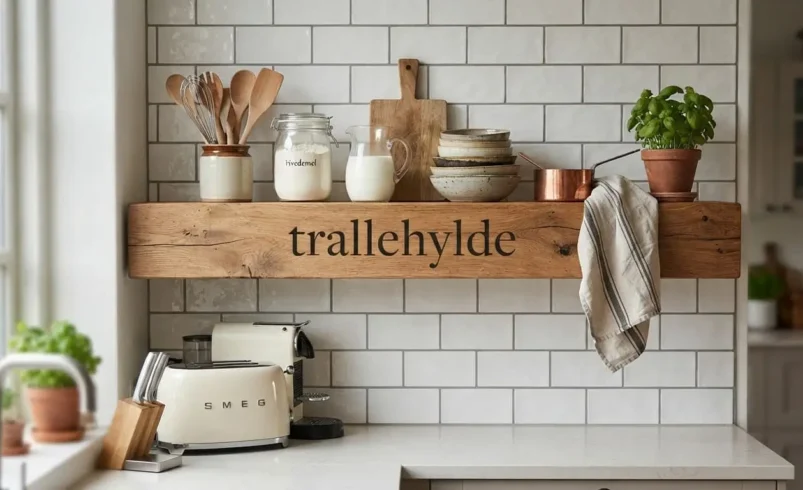
Trallehylde: Danish Slatted Shelving for Modern Homes
November 24, 2026
0
Scandinavian interiors are often admired for making everyday objects feel considered rather than complicated. A well-placed shelf, a useful bench, or a simple storage unit can contribute to
Scandinavian interiors are often admired for making everyday objects feel considered rather than complicated. A well-placed shelf, a useful bench, or a simple storage unit can contribute to the character of a room while quietly solving a practical problem. This balance between appearance and usefulness is part of the appeal of furniture inspired by Nordic design.
Trallehylde is an interesting term in this context because it brings together two Danish words associated with a particular kind of structure and a familiar piece of furniture. The first part, tralle, refers to a slatted or gridded plank-like construction. The second, hylde, means a shelf. Read together, the compound suggests a shelf made from, or inspired by, a slatted structure.
The distinction matters. A traditional Danish tralle is not simply another word for a shelf, and a trallehylde should not automatically be confused with a wheeled storage trolley. The term points more naturally towards a slatted shelf or shelf-like construction. Its exact use can still depend on the product, maker, or context in which it appears.
This makes Trallehylde a useful subject for exploring the relationship between materials, construction, and home organization. From a rustic reclaimed-wood display to a clean-lined wall shelf, slatted construction can create visual texture without making a room feel crowded. Understanding the term helps shoppers and design enthusiasts distinguish the furniture itself from products that only share a similar name.
Quick Facts About Trallehylde
Fact
Details
Term
Trallehylde
Language of Origin
Danish
Literal Word Components
Tralle refers to a slatted or gridded plank; hylde means shelf
Furniture Category
A descriptive term for a slatted shelf or shelf-like storage piece
Design Characteristics
Visible gaps, repeated parallel elements, an open appearance, and an emphasis on construction
Common Materials
Timber, reclaimed wood, and, in some contemporary interpretations, metal supports or mixed materials
Traditional Inspiration
The Danish tralle, a slatted plank or grating traditionally associated with scaffolding and other practical structures
Interior Design Association
Often compatible with Scandinavian, Nordic-inspired, rustic, minimalist, and contemporary interiors
Providing accessible storage while allowing the supporting structure and the objects displayed to remain visually open
Related Furniture Styles
Slatted shelving, open shelving, reclaimed-wood furniture, wall-mounted shelves, and modular storage
Modern Relevance
Offers a way to combine useful storage, visible material texture, adaptable styling, and interest in reuse
Understanding What Trallehylde Actually Describes
Before considering where a Trallehylde might fit in a home, it helps to understand the word itself. Danish compounds often combine two meaningful elements to describe an object, material, or function. Trallehylde follows that general pattern, although the compound should not be treated as a universally standardized furniture category with one fixed design.
The Meaning ofTralle
The Danish word tralle has a specific structural meaning. Den Danske Ordbog, the Danish Dictionary, defines the noun as a long, narrow board made from strips or battens joined together to form a grid. It notes that traller are primarily used as platforms on scaffolding and that they have also been used to make furniture such as benches.
That definition provides an important starting point. A tralle is not simply a flat plank of solid timber. Its defining feature is the arrangement of separate elements that create a slatted or gridded surface. The gaps between those elements are part of its construction rather than decorative lines added to an otherwise solid board.
This open structure can be practical. Depending on its original purpose and construction, it may allow drainage, airflow, or a degree of visibility through the surface. In furniture, the same visual quality can create a lighter appearance than a thick, solid panel.
The Meaning ofHylde
The second part, hylde, is the Danish word for a shelf. Den Danske Ordbog describes it as a horizontal surface used to store or display objects, often as part of a cabinet, shelving unit, or wall-mounted arrangement.
Combining the two elements gives a straightforward interpretation: a shelf associated with a tralle-like slatted construction. It is a useful descriptive reading, not proof that every Danish speaker or furniture retailer uses Trallehylde as the formal name for one particular product design.
The dictionary entries for the two words are more reliable for explaining their individual meanings than an unsupported claim about a single official definition for the compound.
Why the Term Should Not Be Translated as “Trolley Shelf”
A possible source of confusion is the similarity between tralle and English words such as “trolley.” They should not be treated as interchangeable.
A trolley is generally a movable cart or platform, often fitted with wheels. A Danish tralle, by contrast, is a slatted or gridded plank-like structure. A piece of furniture made with slatted boards may be stationary, wall-mounted, or freestanding. It does not become a trolley simply because the word looks or sounds similar.
A wheeled storage cart can certainly have shelves, including slatted ones, but mobility is a separate design feature. If a product has wheels, its description should make that clear rather than relying on the word Trallehylde alone.
From Practical Slatted Construction to Furniture Design
The appeal of a Trallehylde-inspired shelf lies partly in the way a practical construction can become an interior feature. A structure originally associated with utility can be reinterpreted through careful material selection, finishing, proportions, and placement.
The Character of a Slatted Surface
A slatted shelf is made from a series of narrow elements arranged with spaces between them. These elements may run lengthwise, crosswise, or in a more complex grid. The layout influences both appearance and function.
Parallel slats create a strong sense of direction. They can make a shelf appear longer, emphasize the grain of the timber, and introduce a repeated rhythm. A grid-like arrangement feels more structured and may resemble a platform or open lattice.
The spaces between the slats also affect how the shelf is used. Small objects may need a tray or a solid insert to prevent them from slipping through. Larger decorative pieces may sit comfortably on the open surface. The design is therefore not only an aesthetic decision; it changes what the furniture can hold conveniently.
The Appeal of Visible Construction
Many contemporary interiors value materials that look honest and understandable. A shelf with visible slats makes its construction part of its appearance. Instead of hiding every joint or support, it allows the viewer to see how the surface is formed.
This does not mean every slatted shelf is automatically minimalist or Scandinavian. The overall result depends on its scale, material, colour, hardware, and surroundings. A rough reclaimed timber version may feel rustic, while a finely finished shelf with restrained proportions may sit comfortably in a contemporary Nordic-inspired room.
Visible construction can also make a small piece of furniture more visually interesting. The repeated lines provide detail without requiring elaborate ornament.
An Open Look Without Losing Practicality
Solid shelves create a continuous surface. Slatted shelves introduce gaps, which can make the overall unit appear less visually dense. In a compact room, that openness may help the furniture feel less imposing.
However, open construction is not always the best choice. A shelf intended for small stationery items, loose jewellery, or tiny kitchen accessories may be more useful with a solid top. A slatted version can still work if the owner uses baskets, containers, or trays suited to the gaps.
The best design is the one that matches the objects it needs to support.
Materials That Shape the Look and Performance
Material choice affects how a Trallehylde-inspired shelf looks, how it ages, and how it should be maintained. It also influences construction, installation, and the types of objects it can reasonably support.
Solid Timber
Wood is a natural choice for a slatted shelf because it can be cut into narrow strips and assembled into a repeated pattern. Oak, pine, ash, beech, and other timber varieties can create different visual results.
Oak often has a pronounced grain and a substantial appearance. Pine is usually associated with a lighter, more informal look. Ash can offer a clear grain pattern, while beech tends to have a relatively even appearance. These are general material characteristics, not guarantees about every board or finished product.
The wood species alone does not determine quality. The grade of timber, moisture condition, thickness, joinery, finish, and workmanship all matter. A carefully assembled shelf made from modest materials may perform better than a poorly constructed piece made from an expensive species.
Reclaimed Wood
Reclaimed timber can give a shelf a more individual character. Previous use may leave variations in colour, marks, small holes, or signs of age. For people who like furniture with visible history, these irregularities can be part of the appeal.
Reclaimed material also raises practical questions. Buyers should find out whether the wood has been cleaned, inspected, dried, and prepared for indoor use. Old boards may have uneven surfaces, loose sections, or residues from earlier coatings. Their condition should be assessed before they become part of household furniture.
Reuse can be a thoughtful choice, but it should not be treated as automatically sustainable in every circumstance. Transport, preparation, replacement parts, and the lifespan of the finished piece all contribute to its overall environmental impact.
Metal Supports and Mixed Materials
A slatted shelf may use timber for its visible surface and metal for brackets, frames, or connecting components. Black or dark-finished metal can create contrast against pale wood, while a light metal finish may make the structure appear more discreet.
The connection between the materials is important. Metal brackets must suit the shelf’s dimensions and intended installation. The fact that a shelf has metal supports does not automatically make it suitable for heavy objects.
Mixed-material construction can be especially useful where the design needs a strong visual frame around a relatively open wooden surface.
Surface Finishes
A finish changes the appearance and maintenance needs of timber. Common options include clear oil, hardwax oil, varnish, lacquer, stain, and paint. Each produces a different result.
A clear finish may preserve much of the wood’s natural appearance. Stain changes its colour while allowing some grain to remain visible. Paint creates a more uniform surface and can make the shelf feel more contemporary or decorative.
The right finish depends on the room and intended use. A kitchen shelf may need a surface that can be wiped clean, while a decorative shelf in a bedroom may have less demanding maintenance requirements. Always follow the finish manufacturer’s care instructions.
Where a Trallehylde-Inspired Shelf Can Work at Home
A slatted shelf can be useful in many rooms, but its suitability depends on its dimensions, construction, mounting system, and the objects placed on it. It should be selected for a particular job rather than treated as a universal storage solution.
In the Living Room: Display Without Visual Heaviness
In a living room, a slatted shelf can provide a place for books, small plants, framed photographs, or carefully chosen decorative objects. Its open construction can help a display feel less like a solid block of furniture.
A longer shelf above a low cabinet may create a visual connection between separate pieces. A smaller shelf beside a reading chair can hold a few books and a lamp, provided its size and support are appropriate.
The key is restraint. Filling every available space can remove the visual openness that makes slatted furniture attractive. Leaving some sections clear allows the repeated lines of the structure to remain visible.
In the Bedroom: Everyday Items Within Reach
A compact wall-mounted shelf can serve as a bedside surface when a traditional table is too large. It may hold a book, glasses case, or a small decorative object.
The design needs to suit the actual routine of the room. A slatted shelf with wide gaps may not be convenient for small loose items. A tray can create a more dependable surface without changing the shelf itself.
For a child’s or teenager’s room, installation and stability are especially important. Furniture should be suitable for the age of the user, securely mounted where required, and used according to the manufacturer’s instructions.
In the Kitchen: Useful Display and Light Storage
A kitchen shelf can keep frequently used items visible and accessible. A slatted design may work for larger containers, selected serving pieces, or decorative objects.
It is not necessarily ideal for every kitchen item. Small spice jars, loose packets, and narrow utensils may be unstable on widely spaced slats. A solid tray or container can help, but it is often simpler to choose a shelf with a continuous surface when small items are the main purpose.
The shelf should also be positioned away from excessive heat, moisture, and areas where grease or cooking residue can build up. Timber finishes need to be appropriate for the environment.
In the Hallway: A Small Landing Place
Hallways often need compact furniture that helps keep everyday belongings organized. A shallow shelf can provide a place for a small decorative object, a key tray, or a basket.
A slatted surface may introduce warmth into an otherwise plain entrance area. However, a wall shelf should not obstruct movement or become a hazard in a narrow passage. Its depth, height, and mounting arrangement should be planned around the available space.
If the household needs a place for shoes, bags, and coats, a dedicated hallway unit may be more practical than a small shelf alone.
In the Home Office: Storage With a Lighter Appearance
A home office can benefit from shelves that keep books, folders, and accessories organized. A slatted shelf may be suitable for larger objects or decorative storage boxes.
For paperwork, small stationery, and electronic accessories, a solid surface is often more convenient. A hybrid design can combine slatted sections for display with solid shelves or containers for everyday supplies.
The shelf should also be placed so that it does not interfere with lighting, screens, cables, or comfortable movement around the desk.
Choosing a Style That Suits the Room
The same basic slatted structure can look very different depending on the finish and surrounding furniture. It is worth considering the room as a whole rather than selecting a shelf only because it looks attractive in a product photograph.
Nordic-Inspired Simplicity
A Nordic-inspired arrangement often uses restrained colours, natural materials, and furniture that serves a clear purpose. A pale timber shelf with simple supports can fit this approach without needing decorative detailing.
The visual balance is important. A room does not need to be entirely white or filled with light wood to feel Scandinavian-inspired. Soft neutrals, muted greens, darker accents, textiles, and a mixture of old and new furniture can all contribute to a calm interior.
Rustic and Reclaimed Character
A reclaimed slatted shelf can suit interiors that include textured fabrics, aged timber, ceramics, and handmade objects. Its marks and irregularities may provide contrast against smoother surfaces.
This look is strongest when the materials feel intentional. Combining several heavily distressed pieces in a small room can make the space feel cluttered. One distinctive reclaimed shelf may have more impact than a whole collection of competing rustic elements.
Contemporary Minimalism
In a contemporary interior, the shelf can be treated as a simple geometric feature. Clean edges, even spacing, and a consistent finish can help the slatted structure look refined.
The objects displayed should be selected carefully. A few well-proportioned pieces can highlight the shelf’s form more effectively than a crowded arrangement.
Industrial Influence
Metal brackets, dark finishes, and more substantial timber can introduce an industrial character. This combination can work alongside exposed brick, concrete-look surfaces, or darker furniture.
The shelf does not need to imitate factory equipment to achieve this effect. A modest amount of metal detail may be enough to connect it with the rest of the room.
Practical Details to Check Before Buying
A shelf is only useful when it fits the available space and performs the job expected of it. Product photographs may show the finish and overall style, but they do not always communicate every practical detail.
Measure the Available Space
Measure the wall or floor area where the shelf will go. Consider width, height, depth, nearby furniture, door movement, and access to sockets or switches.
Depth is particularly important. A shelf that looks narrow in a photograph may project further into a room than expected. In a hallway or beside a desk, even a small difference can affect movement.
If the shelf is intended to sit above furniture, check the relationship between the two pieces. The result should feel proportionate rather than squeezed into the available gap.
Match the Shelf to the Objects
Think about what will actually be stored. Books, large ceramics, folded textiles, and small accessories have different requirements.
For example, a family that wants to display a few large plant pots may prefer a substantial shelf with a continuous surface. Someone arranging light decorative objects may enjoy the visual texture of open slats.
A shelf should not be chosen solely for the objects shown in a promotional image. Consider the items in the household and how often they will be moved or accessed.
Understand the Support System
Wall-mounted shelves rely on a suitable combination of brackets, fixings, wall material, and installation. The type of wall matters: masonry, timber framing, plasterboard, and other surfaces require different fixing approaches.
Freestanding shelves have different stability considerations. Their base, frame, joint quality, and overall proportions affect how securely they stand.
Follow the manufacturer’s installation instructions. If the wall type or fixing method is uncertain, ask a suitably qualified installer rather than guessing.
Never Assume a Universal Weight Limit
There is no single load capacity for all Trallehylde-inspired shelves. The safe load depends on the individual product’s materials, dimensions, joinery, brackets, fixings, wall condition, and installation quality.
A product’s stated load limit should be followed exactly as provided by its manufacturer. Do not estimate capacity from appearance, timber thickness, or the number of slats. A shelf that looks sturdy may still have weak connections or unsuitable wall fixings.
Distribute objects as instructed, avoid overloading, and do not use a decorative shelf as a seat, step, or climbing support.
Trallehylde Compared With Other Shelf Types
The term is easiest to understand when compared with familiar storage designs. These comparisons describe general construction differences; individual products can vary.
Slatted Shelf Versus Solid Wooden Shelf
A slatted shelf has gaps between its structural elements. A solid wooden shelf has a continuous surface.
The slatted version can look lighter and reveal more of the objects or wall behind it. It may also allow air to pass through the surface. A solid shelf is generally more suitable for small items that need an uninterrupted base.
Neither is automatically better. The choice depends on storage needs and visual preference.
Slatted Shelf Versus Floating Shelf
A floating shelf is defined mainly by the way its support is concealed or visually minimized. It may have a solid or slatted surface.
A Trallehylde-inspired shelf is described by its slatted construction rather than by whether its support is visible. A slatted shelf can be mounted with visible brackets, concealed hardware, or a freestanding frame, depending on the design.
Slatted Shelf Versus Slatwall
Slatwall is a wall panel or display system with grooves designed to accept compatible fittings. It is often used in retail environments, workshops, and adaptable storage spaces.
A slatted shelf is different. Its surface is made from separate strips or battens, while a slatwall panel generally uses a continuous panel with shaped grooves. The two systems may both support shelves or accessories, but their construction and installation are not the same.
Slatted Shelf Versus Mobile Storage Trolley
A mobile storage trolley is a cart designed to move, usually with wheels or castors. It may have solid trays, wire baskets, or slatted surfaces.
A Trallehylde-inspired shelf does not need to move. Its defining feature is the slatted shelf construction, not mobility. A wheeled unit may combine both characteristics, but the terms describe different aspects of the furniture.
Maintenance: Keeping Wood and Metal Looking Their Best
The care routine depends on the materials and finish. A timber shelf may need different attention from one made mainly of metal or engineered board.
Regular Cleaning
Remove dust with a soft cloth or suitable brush. The gaps in a slatted shelf can collect dust more readily than a smooth surface, so cleaning between the slats may be necessary.
Avoid soaking timber. Excess moisture can affect wood, joints, and finishes. Use only cleaning products recommended for the specific surface.
Protecting Timber
Direct sunlight can gradually change the appearance of wood. Large changes in temperature or humidity may also affect some timber products. Position the shelf with its material and finish in mind.
If the surface has an oil finish, it may need periodic maintenance according to the manufacturer’s instructions. Varnished or lacquered surfaces may require a different approach. Do not apply a new coating without checking whether it is compatible with the existing finish.
Checking Joints and Fixings
Occasionally inspect the shelf for movement, loose connections, or signs of damage. For wall-mounted pieces, check that the shelf remains secure and that the fixings show no signs of loosening.
If a shelf becomes unstable or damaged, stop using it until the problem has been assessed and corrected. Do not attempt to compensate for a weak structure by simply reducing the number of objects without checking the cause.
Why Slatted Shelving Remains Relevant
Modern homes often need furniture that can adapt to changing routines. A shelf may begin as a display area and later become a place for books, storage baskets, or everyday household items. Simple construction can make this kind of furniture easier to integrate into different rooms and styles.
Flexible Use Over Time
A well-proportioned shelf can move between roles as household needs change. A living-room display shelf might later be used in a study. A small hallway shelf could become a storage surface in a bedroom.
This flexibility is one reason straightforward furniture remains useful. It does not depend on a highly specific decorative trend to make sense in a home.
Material Reuse and Longer Product Life
Interest in reclaimed timber and repairable furniture has encouraged more attention to how materials are sourced and used. A shelf made from reused boards may give an existing material a new purpose.
However, sustainability is not established by appearance alone. Buyers can ask where the material came from, whether it was prepared for indoor use, how the product is assembled, and whether it can be repaired if a component becomes damaged.
A durable piece that remains useful for many years may be more valuable than a fashionable item that needs frequent replacement.
The Balance Between Display and Storage
A shelf is both a practical surface and part of the room’s visual composition. Slatted construction adds texture while allowing more of the wall and surrounding space to remain visible.
This balance can be especially useful in smaller homes, where bulky furniture may make a room feel crowded. A carefully selected open shelf can provide useful storage without visually dominating the space.
Frequently Asked Questions About Trallehylde
1. What does Trallehylde mean?
Trallehylde is a Danish compound that can be understood as a shelf associated with a slatted or gridded structure. Tralle refers to a slatted plank or grating, while hylde means shelf. The exact use of the compound can depend on the product or context.
2. Is Trallehylde a Danish furniture term?
Its components are Danish words, but that does not establish one universal furniture category with a fixed design. It is best understood descriptively as a shelf made from, or inspired by, a tralle-like slatted construction.
3. What makes a slatted shelf different from a normal shelf?
A slatted shelf uses separate strips or battens with spaces between them. A conventional solid shelf has a continuous surface. Slats create a more open appearance, while a solid surface is often more convenient for small objects.
4. Which materials are suitable for a Trallehylde-inspired design?
Timber is a natural choice, including varieties such as oak, pine, ash, and beech. Reclaimed wood and metal supports may also be used. The best material depends on the intended appearance, environment, construction, and maintenance requirements.
5. Can a slatted shelf be used in a kitchen?
Yes, if its design and finish suit the kitchen environment. It can display larger containers or decorative pieces, but widely spaced slats may not support small jars and loose items conveniently. Moisture, heat, and cleaning requirements should also be considered.
6. Is a Trallehylde the same as a storage trolley?
No. A storage trolley is generally a movable cart, often with wheels. Trallehylde refers to a shelf associated with slatted construction. A trolley could include slatted shelves, but the two terms do not mean the same thing.
7. How should buyers check whether a slatted shelf is suitable?
Check its measurements, materials, joinery, support system, installation requirements, and stated load capacity. Consider the size and weight of the objects it will hold. Never assume that a shelf can support a particular load based only on its appearance.
8. How can wooden slatted shelves be maintained?
Dust the surface and gaps regularly, avoid excessive moisture, and follow the care instructions for the finish. Inspect joints and fixings occasionally. Oiled, varnished, painted, and lacquered surfaces may each require different cleaning methods.
9. Does a slatted shelf suit a minimalist interior?
It can. Repeated lines and visible construction provide texture without requiring elaborate decoration. A simple finish, balanced proportions, and a restrained display can help it fit a minimalist or Nordic-inspired room.
10. Is every slatted shelf suitable for heavy objects?
No. Load capacity varies with the timber, dimensions, joints, brackets, fixings, wall condition, and installation. Use the manufacturer’s stated limits and instructions for the specific product rather than relying on a general rule.
Conclusion
Trallehylde is an appealing term because it connects a practical Danish construction with a familiar piece of home furniture. Its meaning is best understood through the two words that form it: tralle, a slatted or gridded plank, and hylde, a shelf. Together, they suggest a shelf whose character comes from an open, repeated structure rather than a continuous solid surface.
That structure can bring useful texture to a room, but its value depends on more than appearance. The material must suit the environment, the dimensions must match the available space, and the supports must be appropriate for the intended load. A slatted shelf may be ideal for displaying larger objects, while a solid shelf may serve small everyday items more effectively.
The broader lesson is that thoughtful home organization does not always require complicated furniture. Sometimes a simple construction, made well and placed carefully, can provide both practical storage and a distinctive visual detail. A Trallehylde-inspired design works best when its open character is matched to a real household need.